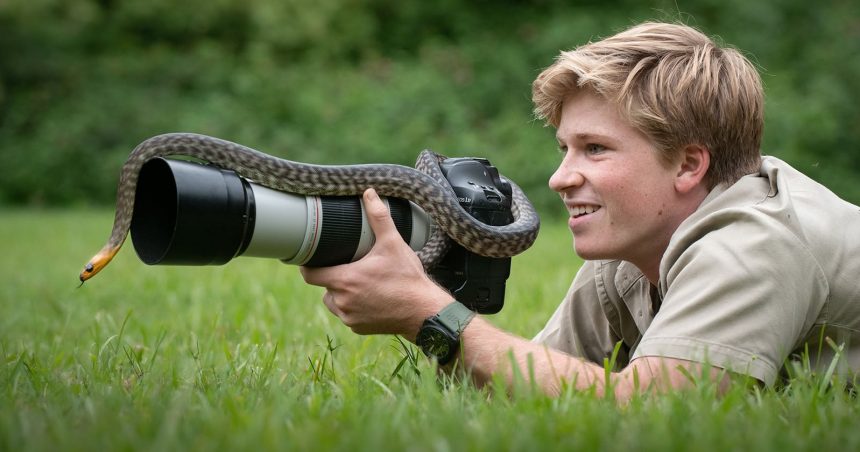
Wildlife photography has always been a battle against the odds — waiting hours for the perfect light, tracking an animal that doesn’t want to be found, and pressing the shutter at the one instant everything aligns. So when a conservationist who has spent his life behind the lens speaks up about artificial intelligence, it’s worth listening.
In an interview with Parade published on July 7, 2026, conservationist, television presenter and wildlife photographer Robert Irwin didn’t mince words about the creeping role of AI in his field. His verdict was blunt: “AI takes away from the artistry of photography.”
Irwin, who is best known for his conservation work and his family’s legacy in wildlife education — and who more recently added a winning turn on Dancing With the Stars to his résumé — used the conversation to reflect on a lifetime spent making images the hard way. For him, photography isn’t just an output. It’s the accumulation of patience, presence and genuine connection with a subject that can’t be faked or synthesized.
That’s the crux of the tension he’s pointing at. Generative AI tools can now conjure a snarling tiger or a soaring eagle in seconds, no field expedition required. The results can be technically dazzling. But Irwin’s argument is that something essential evaporates in the process — the craft, the risk, the truth of an actual moment captured in an actual place.
It’s a debate the photography world has been circling for a while now, and it cuts in several directions:
- Authenticity. A wildlife photograph is, at its core, evidence that something real happened. AI-generated imagery erodes that trust, blurring the line between documentation and fabrication.
- Artistry. Irwin’s point is about the human hand — the choices, the timing, the years of skill that no prompt can shortcut.
- Conservation. For a photographer whose images double as advocacy for the natural world, a fabricated animal doesn’t carry the same weight as a real one that needs protecting.
What makes Irwin’s stance notable isn’t that it’s novel — plenty of photographers have voiced similar unease — but that it comes from someone whose entire career sits at the intersection of imagery and impact. When his photos ask you to care about a species, the fact that they’re real is the whole point.
None of this is a call to ban the technology outright, and Irwin isn’t framing it as a doomsday scenario. It’s more a reminder of what’s at stake as AI seeps into creative disciplines: the difference between a picture that was made and one that was merely generated. In wildlife photography especially, that distinction may turn out to matter more than any megapixel count.