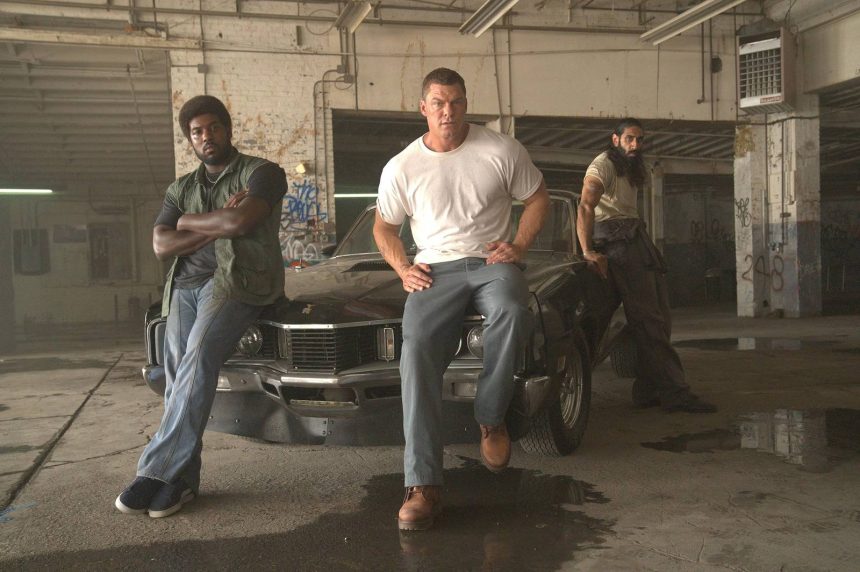
Every so often a film comes along that trusts the audience to keep up without a single line of dialogue holding their hand. Motor City, directed by Potsy Ponciroli, is exactly that kind of experiment — a revenge thriller that arrives in theaters today, July 24, 2026, and dares to strip the genre down to its rawest components.
Fronted by Alan Ritchson, the film leans hard into visual storytelling rather than exposition. In discussing his approach, Ponciroli returns again and again to the idea that action and image can carry emotional weight far more effectively than a monologue. His guiding philosophy is disarmingly simple: “the first person to speak usually loses.” It’s a line that doubles as a filmmaking manifesto, and it explains a lot about the movie’s tense, coiled rhythm.
That restraint puts enormous pressure on the visuals to communicate, and Ponciroli seems to relish it. Rather than spelling out motivations, the camera does the heavy lifting — framing, movement, and body language stand in for the dialogue most thrillers rely on. Ritchson, no stranger to physically imposing roles, becomes the ideal vessel for that method: a presence you read rather than listen to.
The other pillar of the film’s identity is its soundtrack. Ponciroli talks about the movie’s needle drops as more than mood-setting flourishes — they’re structural, punctuating the story and filling the space where conversation would normally live. In a film this deliberately quiet, the music isn’t decoration; it’s a character.
What emerges from the director’s comments is a portrait of a project built on confidence. Withholding dialogue is a gamble that can easily tip into pretension, but Ponciroli frames it instead as an act of respect for the audience — a bet that viewers would rather infer than be told. That’s a bold stance for a genre often defined by its one-liners and villain speeches.
The result, by the director’s own account, is a revenge thriller that feels distinct in a crowded field. Instead of racing from plot point to plot point, Motor City lets tension accumulate in the gaps, trusting composition and needle drops to keep the momentum alive. It’s the kind of formal risk that either lands as a fresh take or falls flat — and Ponciroli clearly believes he’s landed it.
For fans of Alan Ritchson looking for something beyond the standard action fare, and for anyone curious about how far a thriller can push visual storytelling before it breaks, Motor City makes its case in theaters starting today. Whether audiences agree that silence is the sharpest weapon in the genre is the question the film sets out to answer — and it’s not saying much, on purpose.