Shooting a landscape by moonlight sounds like a recipe for a black rectangle. British conceptual artist Darren Almond has spent nearly three decades proving otherwise, and his method is disarmingly simple in principle: point the camera at the world under a full Moon, open the shutter, and wait.
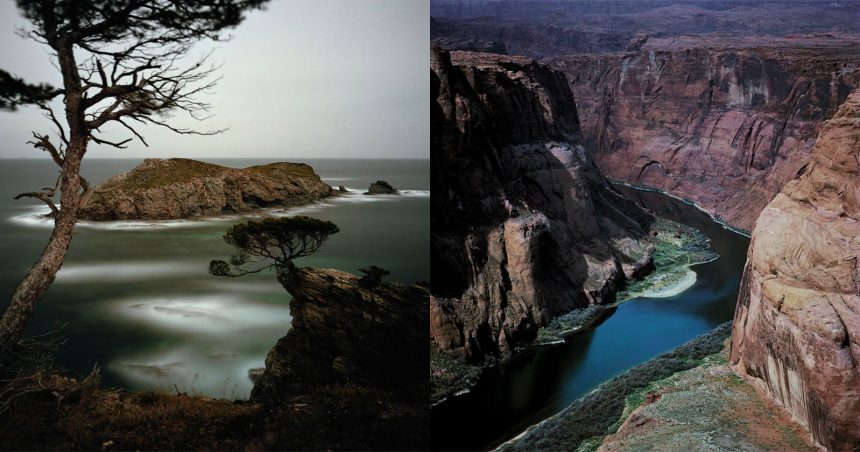
The waiting is the hard part. Almond’s exposures run to 15 minutes — and sometimes longer. Over that quarter of an hour, the faint reflected light of the Moon accumulates on the sensor (or film) until rivers, meadows, cliffs and coastlines emerge looking almost as if lit by early daybreak. The catch is the atmosphere. It never looks like day. Shadows glow softly, water pools like mist, and the stars — moving relative to the ground across such a long frame — smear into faint arcs across the sky.
That last detail is the giveaway that you’re looking at time, not just a place. “With long exposures, you can never see what you are shooting,” Almond says. “But you are giving the landscape longer to express itself.” It’s a nice summary of why long-exposure night work is less about capturing a scene and more about recording a duration.
The photographs are collected in Darren Almond. Fullmoon, published by Taschen. This expanded edition gathers over 370 images shot around the globe since 1998 — from Yosemite and Utah to Patagonia, Bermuda, the Japanese seashore, the Alps and the English meadows. The itinerary reads like a greatest-hits list of “majestic” landscape subjects, but shot at night they take on a stranger, more introspective character.
A few standouts trace the arc of the project:
- Pacific, 2005 — an early example of the technique’s eerie, near-daylight glow
- Moonbow, 2011 — a lunar rainbow, invisible to the naked eye but coaxed out by the long exposure
- Horseshoe Bend, 2012 and Utah North Star, 2012 — American West icons rendered unfamiliar
- Cerro Torre, 2013 — Patagonian granite under starlight
- Pentre Ifan, 2024 and Bermuda, 2025 — the series continuing right up to the present
Almond’s publisher frames the work around “the possibility of romantic ideas of nature today,” and there’s something to that. The images sit somewhere between documentary and painting, letting each landscape “reveal its own history and suggest the direction its future might take.”
Born in Wigan in 1971, Almond works across photography, film and sculpture, with recurring themes of memory, cultural history and time. His solo shows have landed at the ICA and Tate Britain in London, Kunsthalle Zürich, K21 Düsseldorf, Museum Folkwang Essen, SITE Santa Fe and Art Tower Mito in Japan.
For anyone who has ever left a shutter open under a starry sky and wondered what patience could produce, Fullmoon is the definitive answer.