Threading a football-stadium-sized spacecraft past a planet the size of Earth, from a park in Washington State, is not a matter of luck. It’s mathematics — measured, in this case, down to the exact meter.
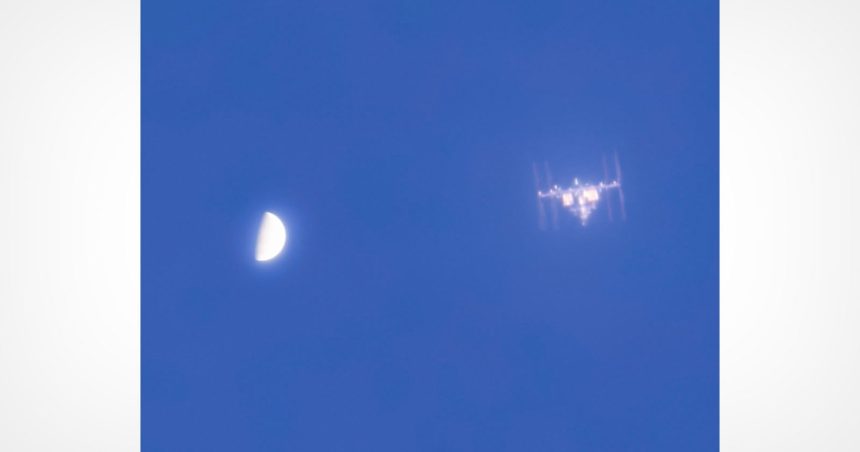
Photographer AJ Smadi has pulled off the second-ever photograph of the International Space Station and Venus sharing the same frame. He also happens to hold the record for the first one. He captured the alignment on Saturday at 6:38 p.m. from a park in Edmonds, Washington, north of Seattle.
The two objects look deceptively similar in size, but that’s pure trickery of perspective. Roughly 135 million kilometers (84 million miles) separate them. Venus is about the same size as Earth; the ISS is roughly the width of a football stadium, orbiting a mere 250 miles overhead.
Catching a 7.5 km/s target
The hard part is that the station doesn’t loiter. “The ISS travels at a mind-boggling 7.5 kilometers per second, making it very hard to photograph,” Smadi explains. An alignment of Venus and the ISS from Earth’s vantage point is rare enough that he had to plan his exact standing position well in advance — a single displacement of a few meters and the geometry falls apart.
To freeze the pass, Smadi shot at a 1/150-second exposure, which gave him 10 usable frames from an uncompressed video clip. He then stacked those frames to squeeze out as much detail as possible from a target that streaks across the field of view in a fraction of a second.
There’s also a nice bit of astronomy baked into the image. “Like the Moon, Venus has phases, and recently emerged from behind the Sun from its full phase, now sitting at just over half illuminated,” Smadi says. So the planet in the frame is a crisp half-lit crescent, not a full disc.
The gear behind the shot
Smadi’s rig is serious glass:
- Telescope: 9.25-inch Celestron Schmidt-Cassegrain, 2,350mm focal length
- Camera: ZWO ASI662MC, built around Sony’s IMX662 sensor
- Filter: UV/IR cut, to block ultraviolet and infrared light
This isn’t Smadi’s first planetary transit rodeo. He previously lined up the ISS with Saturn — a considerably tougher subject given the ringed planet sits roughly 1.39 billion kilometers (863.7 million miles) away, an order of magnitude beyond Venus. He’s also imaged the station itself in surprising detail despite its altitude and blistering orbital speed, and even captured a solar eclipse taking place on Saturn.
It’s a reminder that some of the most jaw-dropping astrophotography doesn’t come from an observatory in the desert, but from a determined photographer, a driveway telescope, and a stopwatch running against orbital mechanics. More of Smadi’s work lives on his Instagram and Reddit.