Imagine updating a robot’s brain not through a cable or a wireless handshake, but by shining a flickering pattern of light directly onto its processor. That’s the idea behind a new optical receiver developed at Cornell Tech, presented last month at the IEEE/JSAP Symposium on VLSI Technology & Circuits.
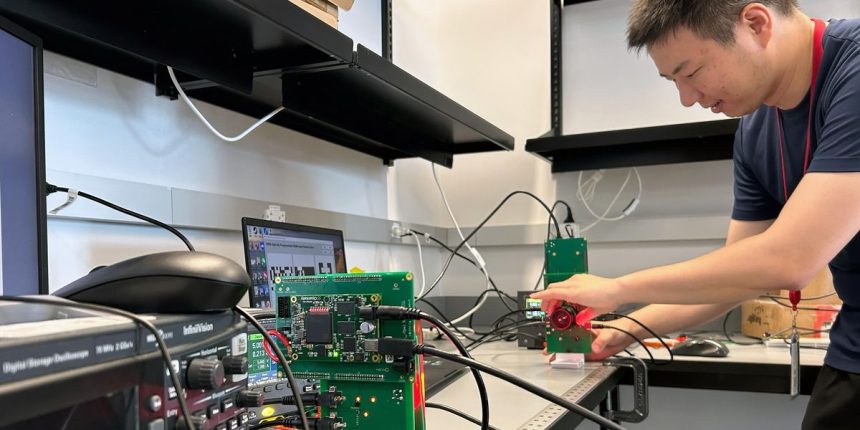
On a lab bench, postdoctoral researcher Yifan He aims the lens of an optical receiver almost a meter away from an LED throwing off a beam of red light. The attached monitor blinks, then shows a grid of squares that looks a lot like a QR code. But this is not your phone scanning a link. Instead of using an image sensor as a first step to decode data, the receiver rewrites its own memory using the photocurrents generated by the incoming light array — and that light could carry the parameters of an AI model.
Why this matters. Modern AI chips rarely have room to store every parameter of a model, so the overflow lives in dynamic random-access memory (DRAM). Shuttling data back and forth between DRAM and the processor over metal wires is expensive and inefficient, a bottleneck that only gets worse as systems scale.
Optical links move data at high bandwidth with far less energy loss than copper. The catch is that today’s optical receivers lean on power-hungry analog circuits to translate light into bits, which eats into the savings. The Cornell Tech approach sidesteps that by receiving rapid flashes of digital, QR-code-like matrices, letting chips adjust model parameters through fully digital optical communication.
How light flips the bits. In this setup, DRAM sits alongside the transmitter, while the receiver is folded into the processor’s static random-access memory (SRAM). The SRAM cells are modified to include photodiodes — when light strikes each one, it produces a current that flips the binary value stored in the cell.
Alignment is the tricky part. Since a transmitter and receiver won’t sit perfectly square to each other, the chip references a data frame describing the expected position of each pixel, then uses a calibration circuit to lock on to the real data even if the beam arrives slightly tilted.
The prototype’s limits. The transmitter in the lab is only a proof of concept, projecting a static 14×14-bit matrix through a metal mask. For real-world use, the team needs an optical transmitter that can rewrite the light matrix millions of times per second, pushing gigabits per second. They’re collaborating with optics groups to build one.
There’s another hurdle: the photosensitive bit cells are physically larger than conventional SRAM cells, meaning a chip fits less memory — a trade-off that could erode the efficiency gains. Shrinking those cells through transistor optimization and CMOS scaling is an ongoing effort.
The likely payoff is at the edge. Warehouse and factory robots could have their AI models refreshed via beamed light, saving time and energy, while memory-starved microrobots might one day benefit too. Commercialization is still years away, but as intelligence keeps migrating into the devices around us, light-based memory links could become a serious contender.