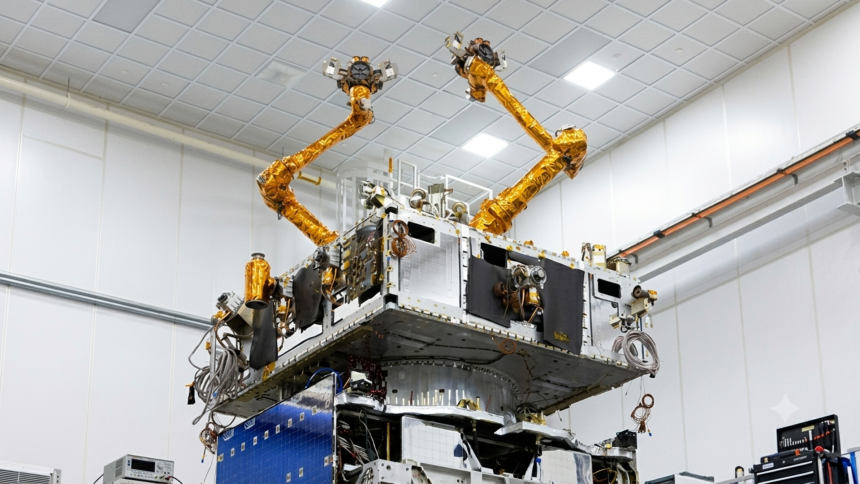
Space is filling up with dead satellites, and the industry has quietly started building tow trucks and repair crews to deal with them. The latest is Northrop Grumman’s Mission Robotic Vehicle (MRV), which lifted off on July 21, 2026 from Cape Canaveral Space Force Station and is now circling the planet, arms ready.
Built by Northrop Grumman’s SpaceLogistics subsidiary, the MRV is not your average satellite. It carries two fully articulated robotic arms plus a set of specialized tools, effectively turning it into a free-flying mechanic. The main spacecraft weighs in at 3,000 kg and is designed to service up to thirty 2,000 kg satellites across its operational life — a fleet-scale ambition rather than a one-off rescue.
Here’s where it gets clever. Rather than staying permanently docked to a single client, the MRV plays courier. It installs small Mission Extension Pods (MEPs) — compact 400 kg spacecraft that latch onto an ailing satellite and hand it up to 6 years of extra service life. Think of the MEPs as strap-on jetpacks, and the MRV as the technician who bolts them on. Once a pod is fitted, the MRV moves along to the next customer.
The economics of this are hard to argue with. Building and launching a replacement geostationary satellite is astronomically expensive, so extending an existing bird’s life by keeping it on station is a bargain by comparison. And every satellite kept alive — or eventually nudged into a graveyard orbit — is one less piece of debris cluttering an increasingly crowded neighborhood.
But those same dexterous arms have raised eyebrows. The MRV grew out of a partnership involving DARPA and the U.S. Naval Research Laboratory, and the technology that lets a spacecraft grab, inspect and manipulate another object is dual-use by nature. A robot that can gently refuel a friendly satellite could, in principle, disable a hostile one. That has fueled talk of “close-combat” satellite scenarios and put orbital servicing squarely in the middle of the debate over the militarization of space.
For now, the mission on the table is decidedly constructive: keep valuable hardware working longer and take some pressure off the debris problem. On-orbit servicing has long been the stuff of engineering conference slides; with the MRV actually in orbit, it becomes something operators can book.
Whether the next decade sees these arms mostly refueling satellites or occasionally wrestling with them may depend less on the engineering and more on geopolitics. The hardware, at least, is up there and ready to grab.