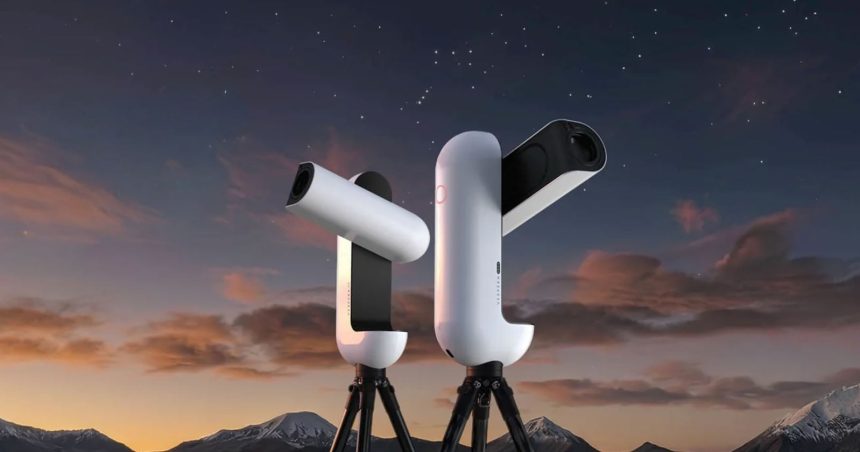
Vaonis has rolled out two new smart telescopes aimed squarely at astronomy enthusiasts who’d rather point a phone at the night sky than fiddle with polar alignment and collimation. Meet the Vespera 3 and the Vespera Pro 2, both unveiled in May 2026 and available now.
The two instruments share a lot of DNA. Each carries a 50mm aperture with a 245mm focal length at f/4.9, and both benefit from an all-new optical design built around three-group, flat-field apochromatic quadruplet optics. In plain terms, that’s a fancy lens formula engineered to keep stars sharp and pinpoint right out to the corners of the frame — exactly where cheaper optics tend to smear them.
Where the two diverge is the sensor, and that’s what separates the everyday stargazer from the pixel-hungry enthusiast.
- Vespera 3 uses a Sony IMX 585 sensor at 8.3MP, delivering 3,840×2,160-pixel captures — a clean 4K-shaped frame that’s easy to share and easy to process.
- Vespera Pro 2 steps up to a Sony IMX 676 sensor at 12.5MP with a square 3,536×3,536-pixel readout, plus 225GB of internal storage for stacking long sessions without offloading to your phone every few minutes.
Both models are rated for 11 hours of battery life, which is generous enough to chase a target from twilight straight through to the early hours without hunting for a power bank in the dark. That endurance matters more than it sounds — deep-sky imaging is a game of patience, and the longer these things can keep integrating light, the more detail bubbles up out of the noise.
The pricing splits the range neatly. The Vespera 3 lands at US$2,490, while the Vespera Pro 2 sits at US$2,990 — a US$500 gap that essentially buys you the higher-resolution square sensor and the onboard storage. For anyone primarily interested in wide, framed views of nebulae and galaxies, the standard Vespera 3 covers plenty of ground. For those who want maximum resolution and a square canvas that suits certain deep-sky objects better, the Pro 2 is the obvious pick.
What both share is Vaonis’ whole reason for existing: taking the intimidating, hardware-heavy hobby of astrophotography and compressing it into something you can set up on a balcony, tap a few times, and walk away from. The optics are the headline upgrade here, and paired with modern Sony sensors, these two should pull surprisingly rich images out of light-polluted suburban skies.
If you’ve been eyeing a smart telescope but held off on earlier generations, the refreshed optical design across both models makes this a worthwhile moment to look again.