Imagine a camera so vast it can freeze half a million galaxies in a single frame. That’s exactly what the LSST Camera (LSSTCam) has just done, delivering a jaw-dropping portrait of one of the most heavily studied patches of the Universe.
Built for the Vera C. Rubin Observatory’s Legacy Survey of Space and Time, this is not a gadget you’ll ever slot into a camera bag. It’s the largest digital camera ever constructed for astronomy, and its numbers read like science fiction.
At its heart sits a 3.2 Gigapixel focal plane spanning a 9.6 square degree field of view. To hit that resolution, engineers assembled 189 individual CCDs arranged into 21 “rafts” — a modular jigsaw of silicon sensors pointed at the cosmos. Each pixel corresponds to 0.2 arcseconds on the sky, fine enough to resolve staggeringly distant objects, and the entire focal plane reads out in just 2 seconds.
The optics run through six optical filters, letting astronomers slice the same view across different wavelengths of light. That’s how a single exposure can be transformed into scientific gold — mapping distances, ages and motions of objects billions of light-years away.
The project is anything but a solo effort. The camera was manufactured and managed by SLAC National Accelerator Laboratory, with a construction partnership that included Brookhaven National Lab, Lawrence Livermore National Lab, and the National Institute of Nuclear and Particle Physics in France. The price tag for this engineering marvel: US$168 million.
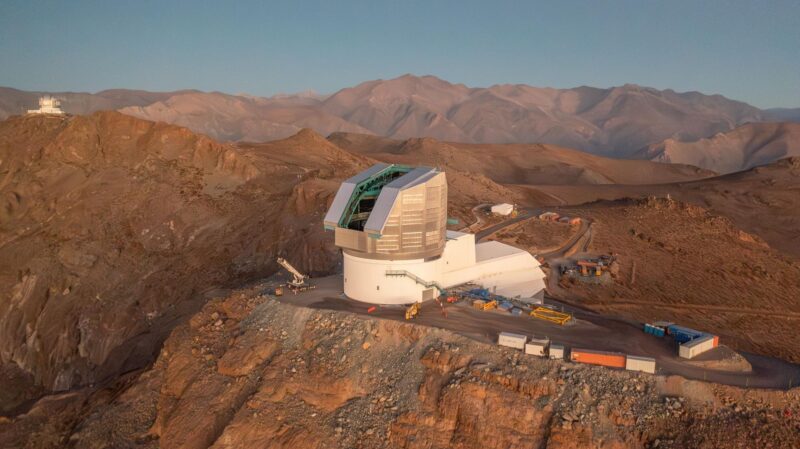
The hardware has been coming together for a while. LSSTCam was mounted on the Simonyi Survey Telescope back in March 2025, and after a lengthy commissioning phase, the full survey officially kicked off on June 29, 2026. It is now actively scanning the southern sky night after night.
What makes the Rubin Observatory special isn’t just raw resolution — it’s the relentless cadence. Over the coming decade, the camera will repeatedly photograph the visible sky, building a time-lapse of the Universe. That approach is tailor-made for spotting things that move or change:
- Asteroids and near-Earth objects tracing across the frame
- Supernovae flaring and fading
- Subtle gravitational lensing that hints at dark matter
The half-million-galaxy image is essentially a taste of what’s coming. Each new night adds more data to a survey designed to catalog billions of stars and galaxies, and to catch transient cosmic events that would otherwise slip by unnoticed.
For all its scale, the appeal here is refreshingly simple: a camera that turns a quiet corner of the sky into a crowded metropolis of galaxies, and does it every couple of seconds. It’s the kind of instrument that reminds you just how much light there is out there waiting to be counted.