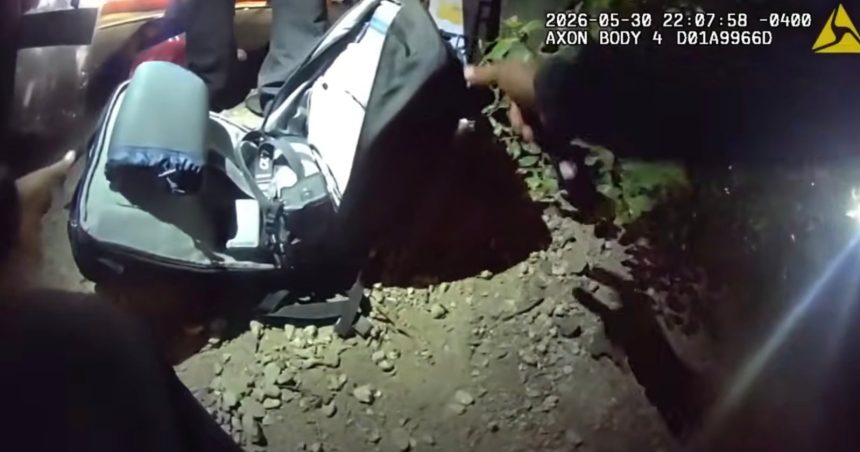
An AirTag tucked inside a camera bag has become the unlikely centerpiece of a criminal case against a New Jersey police sergeant — and now the body camera footage at the heart of it is public.
On May 30, Associated Press photojournalist Angelina Katsanis was covering protests outside Delaney Hall in Newark, an ICE detention facility. As police and demonstrators clashed, she was struck by a wooden beam. Katsanis sought medical attention and left her camera bag behind. When she later returned in a wheelchair to collect her gear, it was gone.
Here’s where the tracking hardware did its job. While Katsanis was in the hospital, the AirTag attached to her bag pinged a location: a home in Sparta, New Jersey, listed to Essex County police sergeant Darryl Brown. Officials reviewing Brown’s body camera footage said it showed him “interacting” with the bag. A search of his home recovered several of the photographer’s missing items, some marked with her name and phone number.
Brown was suspended without pay and charged with third-degree theft — an offense that carries a potential sentence of three to five years in prison and a fine of up to $15,000.
The footage itself only surfaced after a fight. In June, nonprofit outlet The Jersey Vindicator sued the Essex County Prosecutor’s Office when it refused to release Brown’s body-worn camera recording. Officials handed it over on Thursday, and The Jersey Vindicator published it.
The video picks up after protesters and journalists had been cleared from the scene. Brown and other officers move through the area with flashlights, picking through first-aid supplies, food, backpacks, and belongings strewn across the ground, tables, and chairs.
At one point Brown asks, “Anyone need to wash their eyes out? They’ve got everything.” Moments later: “Are we going to leave all this stuff? All they’re going to do is be back tomorrow.”
Then comes the exchange that matters. Officers find an open bag among the belongings, a professional camera visible inside. Brown asks whether it’s a camera, then says, “Give me that sh-t.” The footage shows him closing the bag, moving it aside, and continuing to search nearby items. Another officer quips, “They’ve got a whole flea market over here.”
Brown picks up another object — “What’s this? Just a battery?” — and an officer suggests it’s a charger. Less than two minutes later he tells the others, “You can shut down,” and the recording ends.
Crucially, the footage does not show what happened to the bag afterward. That gap is exactly why the AirTag data has done so much heavy lifting in this case. A cheap Bluetooth tracker isn’t designed to be evidence in a theft prosecution, but its ability to keep reporting a location long after its owner has been separated from a bag is precisely what made the difference here — a quiet reminder of how much modern location tech can reveal.