Sometimes the most astonishing footage isn’t about the gear at all — it’s about being in exactly the right place, with a drone already in the air. That’s what happened to 20-year-old wildlife photographer Alexander Forrest, who filmed what is believed to be the first-ever aerial recording of a humpback whale giving birth off the coast of New South Wales on July 28.
Forrest was standing on a coastal point in northern New South Wales, documenting the annual whale migration along a stretch of ocean nicknamed the “humpback highway,” when he spotted an adult female moving unusually slowly through shallow water. He sent his drone up for a closer look — and immediately feared the worst.
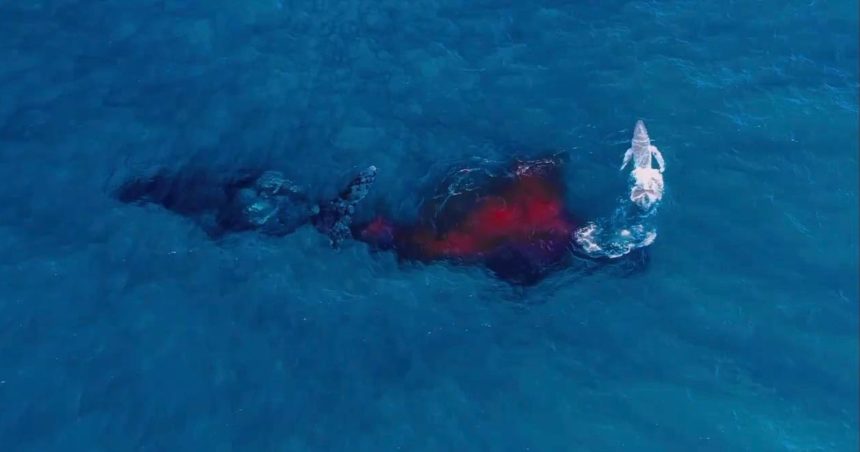
According to The New York Times, the video revealed a large cloud of bright red blood spreading through the sea. Forrest initially thought a predator had attacked the whale. Moments later, the truth emerged: a gray calf appeared beside the adult, and the blood turned out to be a sign of new life, not violence.
“My adrenaline was through the roof,” Forrest said in a statement. “After thousands of hours filming whales from the air, I’ve never witnessed anything comparable.”
The aerial clip is genuinely cinematic. A striking crimson cloud blooms in the water above the mother before a light gray calf breaks free, flicking its tail as it rises. The newborn then lifts its head above the surface, appears to take its first breath, and begins swimming alongside its mother through remarkably clear water.
What makes this so valuable goes beyond the spectacle. After witnessing the birth, Forrest contacted the Organisation for the Rescue and Research of Cetaceans in Australia (ORRCA) to report the sighting and ask that the pair be tracked. He was later joined by ORRCA drone operators Tanya Snowden and Dominic Cotter-Dephoff, who spent several hours filming alongside him.
The drones documented the calf’s first hours of life, capturing details that are almost impossible to observe otherwise:
- the mother’s attentive care for her newborn;
- the calf’s first dives;
- encounters with several other humpback whales that approached the pair.
ORRCA’s head of research, Annie Post, noted that there have been only three previously published observations of humpback whale births — and this is believed to be the first time such an event has ever been recorded from the air.
“It is an extraordinary contribution to our understanding of humpback whale reproduction and maternal behavior,” Post said.
It’s a reminder of how consumer drones have quietly become serious research instruments. A tool most of us associate with holiday reels and real estate shots just delivered a scientific first — filmed from above, without disturbing the animals below.