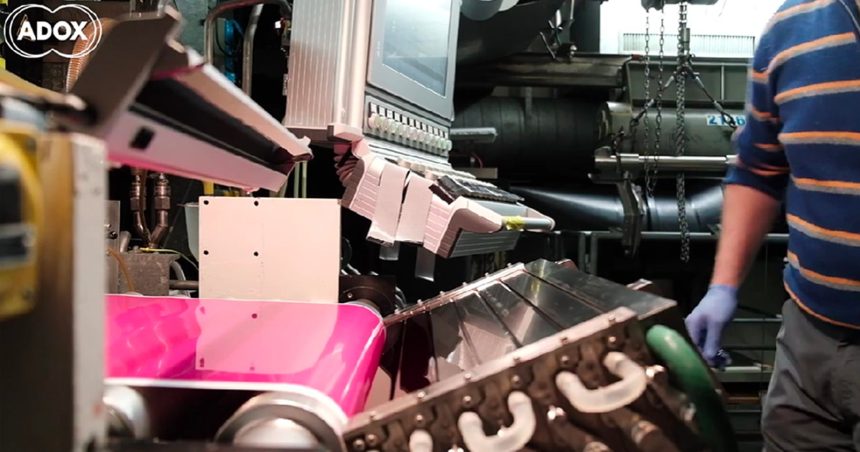
Tucked away in Marly, Switzerland — a town straddling the country’s French-German language frontier — sits a machine that most photographers have never heard of, yet whose fingerprints are all over the images they’ve admired for decades. It’s called Machine E, and it’s a multilayer photographic coating machine that would reportedly cost something in the region of $100 million to replicate today.
Coating machines are the unglamorous heavy industry behind film photography. To make a single frame of color film or a sheet of photographic paper, dozens of impossibly thin, light-sensitive layers must be applied onto a moving base with microscopic precision — each one perfectly aligned, perfectly even, perfectly timed. Get one layer wrong and the whole product is ruined. Machine E was engineered to do exactly this, at scale, and it has been doing it for more than half a century.
Its story starts in the late 1960s, when it was built by Ciba for several million Swiss Francs. Initially the machine handled graphic art films, but it later found its true calling producing Cibachrome, the legendary dye-destruction color material famed for its saturated, archival-grade prints. For serious photographers of the analog era, Cibachrome was as good as color reproduction got — and Machine E was where it came from.
What makes this piece of hardware remarkable in 2026 isn’t nostalgia, though. It’s that the machine is still relevant. Much of the equipment that once produced the world’s film stock has been scrapped, dismantled or left to rust as the industry contracted. Machine E survived — and now it’s entering its next phase under Adox, the German company that has spent years reviving discontinued analog materials and keeping the film ecosystem breathing.
That handover matters more than it might sound. Coating lines like this cannot simply be rebuilt on demand; the expertise, tooling and sheer capital involved put a modern equivalent out of reach for a niche market. Every functioning multilayer coater is effectively irreplaceable infrastructure for the analog world. When one changes hands and keeps running, it’s genuine good news for anyone who still shoots film.
A few things worth appreciating about Machine E:
- Origin: built by Ciba in the late 1960s
- Location: Marly, Switzerland
- Original use: graphic art films, later Cibachrome color material
- Replacement cost today: around $100 million
- Current custodian: Adox
There’s something quietly moving about a Cold War-era Swiss machine still humming along, coating layers measured in microns, as the film revival rolls into the mid-2020s. It’s a reminder that the analog comeback isn’t just about hip cameras and grainy aesthetics — it rests on a fragile chain of industrial artifacts, most of them impossible to rebuild. Machine E is one of the biggest links in that chain, and for now, it’s still very much alive.