Forget the image of gray hulls and helicopters. The latest tool in the US Navy’s counter-narcotics playbook is a pair of unmanned sailing robots that quietly shadowed a suspected smuggling vessel until the humans could move in.
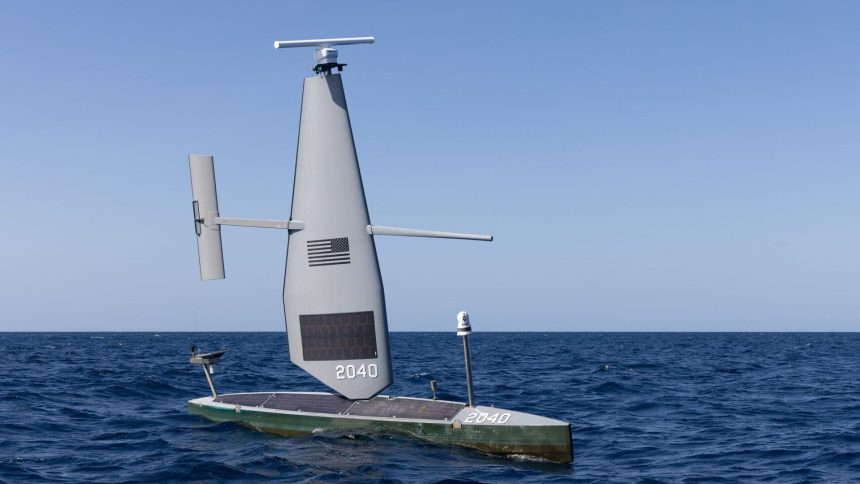
Two Saildrone Voyager vessels tracked a group of suspected drug traffickers across the Caribbean, feeding surveillance data that let the US Navy intercept and seize a haul of cocaine worth more than US$81 million. It’s a striking demonstration of how autonomous surface vessels are moving from experimental curiosities to genuine operational assets.
The appeal is obvious once you think about it. A crewed patrol boat has to stop, refuel, and rotate its exhausted crew. A wind-and-solar-powered robot can loiter for weeks, watching a stretch of ocean without anyone aboard, without burning fuel, and without putting sailors in harm’s way. When you’re playing a waiting game against smugglers who rely on the sheer size of the ocean to stay hidden, patience is a weapon.
The Voyager is built by California-based Saildrone, a company that has made its name deploying autonomous vessels for ocean mapping, climate research, and maritime domain awareness. These are not weapons platforms in the traditional sense — they’re floating sensor suites. Their job is to see, identify, and report, turning a vast and largely empty seascape into something the Navy can actually monitor in real time.
What makes this seizure notable isn’t the tonnage or even the dollar figure, eye-catching as US$81 million is. It’s the proof of concept. Using a swarm — even a modest one of two boats — to persistently track a target and cue a manned interdiction is exactly the kind of layered, human-plus-machine operation that navies around the world have been talking about for years. Here it actually delivered a result you can put a number on.
There’s a broader story here for anyone who follows autonomous technology. The same core ideas driving self-driving cars and delivery drones — persistent sensing, onboard decision-making, remote oversight — are quietly reshaping how the world’s oceans get watched. The difference is scale: a drone boat doesn’t need to dodge pedestrians or read traffic signs, but it does need to survive storms, dodge shipping lanes, and stay useful for weeks at a stretch far from any port.
Autonomous surface vessels won’t replace crewed ships any time soon. But operations like this one suggest they’re carving out a clear niche as tireless, low-cost eyes on the water — doing the dull, dangerous, and endlessly patient work that machines were arguably built for. For the traffickers, it means the ocean just got a lot smaller.