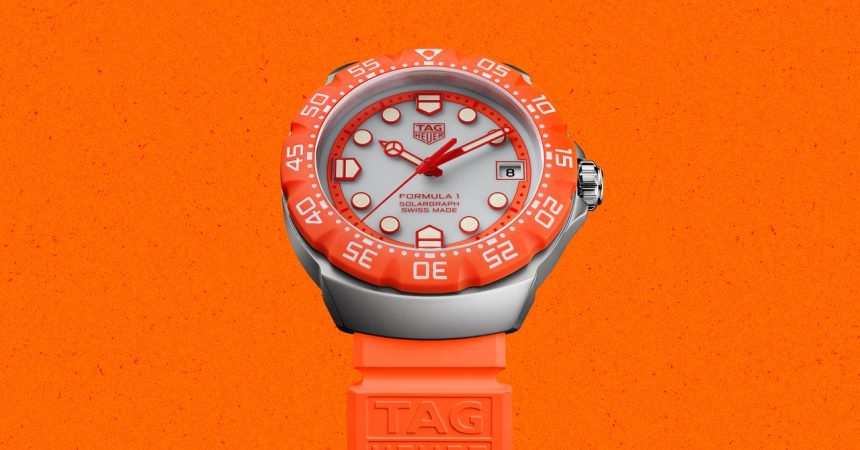
Some watches earn their nostalgia. The bright orange TAG Heuer Formula 1, first seen in the late 1980s as the model 373.513 (later rebadged WA1213), was one of them — a punchy, plastic-happy sports watch aimed at surfers and divers long before it became shorthand for motorsport cool. Now that exact colorway has returned as part of TAG Heuer’s Solargraph revival, and collectors are already calling it “the Zandvoort,” a nod to the final Dutch Grand Prix at the celebrated circuit.
The reborn piece keeps the DNA intact but grows up a little. The case is now 38mm, larger than the original 28mm and 35mm versions, though the grey opalin dial still mirrors the 1980s hue, complete with an orange and red minute track. The design flourishes flanking the case on the rubber strap, echoing the TAG logo, survive the update as well.
You get two ways to wear it. The orange rubber strap edition runs $2,150, while the steel bracelet version is $2,250 — the latter a three-row sand-blasted design rather than the original’s five-row affair, and sold online only, so you won’t find it in stores. Both are limited: 1,500 pieces on rubber and just 1,000 on the bracelet.
The headline upgrade is under the hood. Where the vintage F1 relied on a quartz movement and an Arnite thermoplastic case, the new model runs TAG’s Solargraph solar-powered movement. It’s genuinely low-maintenance: one minute of direct sunlight powers the watch for a full day, a full charge takes under 40 hours of light exposure, and once topped up it keeps running for up to ten months in complete darkness.
The case material has evolved too. TAG has swapped the old thermoplastic for a castor-based bioplastic it calls TH-Polylight, a more eco-friendly polyamide molded over a steel inner core. That combination gives the watch a robustness that most plastic-cased rivals can’t match, while keeping the lightweight, colorful spirit that made the original a hit.
Not everything carried over, though. The vintage rubber straps featured V-shaped grooves on the underside — a clever touch that let surfers and divers wear the watch over a wetsuit and trim the extra-long strap to size with scissors. The new straps drop those grooves entirely, and it’s not hard to guess why: TAG isn’t keen on anyone taking a knife to its 2026 rubber.
It’s worth remembering just how successful the formula was. Watch designer Eddy Burgener conceived the F1 for “American surfers, divers, and other young folks heading for the beach,” leaning on bright, popping colors that echoed the surfboards and clothing of the era. Only later, after TAG entered racing, did the range adopt the Formula 1 name. Whatever the audience, it worked — the line sold more than 3 million units before being shelved.
The orange Solargraph F1 went on sale in August 2026, both editions available to order.