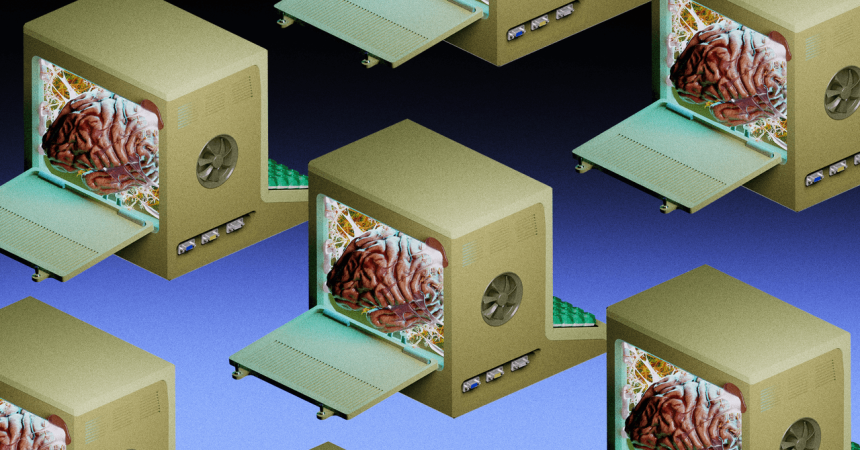
Forget large language models for a moment. In a Melbourne lab, a startup called Cortical Labs is building computers out of the one substance no silicon foundry can print: living human brain cells. Its flagship, the CL-1, is a sleek white box roughly the size of an elongated toaster — and inside, actual neurons are doing the thinking.
The concept is disarmingly simple and slightly unnerving. Scientists take a skin, blood, hair or tooth sample, coax the adult cells back to an embryonic state with special proteins, and let those induced pluripotent stem cells mature into brain tissue. The result is a human brain organoid — a snot-colored clump about the size of a chia seed that spontaneously wires itself together. “Whatever environment you put them in, the first thing that they do is try to connect,” says UC San Diego biologist Alysson Muotri, whose lab grows organoids by the tens of thousands.
Cortical Labs takes a flatter approach, cultivating neural cultures — grown from stem cells donated by the company’s own founder — and loading them into the CL-1. Each unit packs an onboard life-support system capable of keeping up to a million neurons alive for six months, regulating temperature and a precise gas mix of oxygen and CO2. Mess with those settings from the cloud dashboard and, quite literally, the computer dies. That’s a paradigm shift no coder is used to.
Through the Cortical Cloud, researchers can log in remotely and interact with a grid of 59 electrodes, each carrying a tiny living culture. Click a square and you fire an electrical hello to neurons 8,000 miles away, with a sub-millisecond delay; all 59 electrodes spike back in response. The company frames this as “neurons as a service,” and it isn’t shy about ambition — it wants to become the Nvidia of neural computing.
Why bother, when GPUs already dominate AI? Because biology comes with features silicon can’t touch. “When you think about what you want from AI, it’s biology,” says COO Brett Kagan. “You want it to be self-repairing as much as possible. You want it to be adaptable. You want it to be long-lived. You want it to be energy-efficient. These are all features you get for free in biology.”
Cortical Labs made headlines in 2022 when it trained a neural culture on a microchip to play the 1972 Atari game Pong, rewarding correct moves with predictable pulses and punishing mistakes with chaotic bursts. That experiment tested neuroscientist Karl Friston’s theory that self-organizing biological systems minimize surprise — and hinted that living matter, like a computer, is programmable.
For now, the CL-1 is mostly a tool for researchers who’d rather skip the tedious wet-lab husbandry. But if neurons prove to be an efficient, resilient computing substrate, tasks like image recognition could migrate from artificial networks to genuinely living ones. Kagan, never one for modesty, puts it plainly: “The CL-1 is to theoretical neuroscience as the Large Hadron Collider was to theoretical physics.”