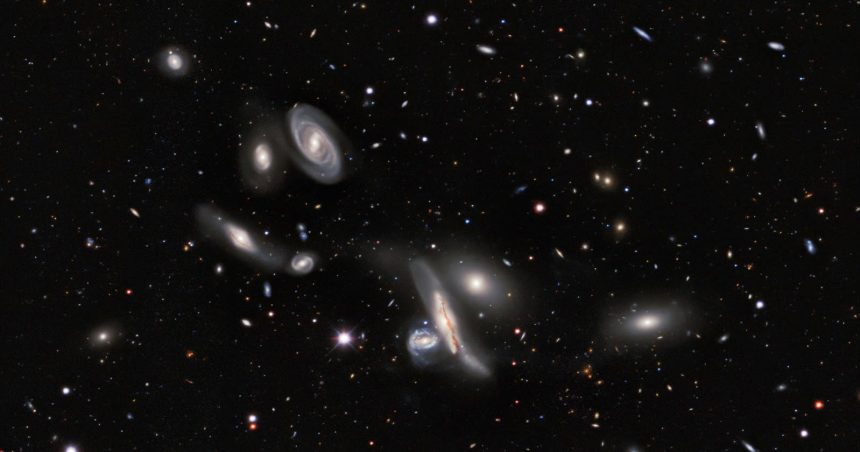
Thirteen years, two telescopes and 263,407 exposures later, astronomers have assembled what is now the largest 2D map of the Universe ever made. Released on August 10, 2026, the DESI Legacy Imaging Surveys map covers roughly 75% of the sky in visible and near-infrared light — and you don’t need a research grant to explore it.
The numbers are the kind that break the brain a little. The final image weighs in at 5.6 trillion pixels, stitched together from all those individual exposures plus supplementary infrared data. Inside it live nearly four billion celestial objects: stars, galaxies, black holes and asteroids, all cataloged and searchable.
Behind the effort sits NSF NOIRLab, with the work managed across the NSF Cerro Tololo Inter-American Observatory, the NSF Kitt Peak National Observatory and the University of Arizona’s Steward Observatory. Two telescopes did the heavy lifting over more than a decade, patiently sweeping the sky again and again to build up the coverage and depth that a project like this demands.
What makes this more than a pretty wallpaper is what it enables. The Legacy Surveys were designed in part to underpin the Dark Energy Spectroscopic Instrument (DESI), feeding it targets for follow-up study. A map this vast becomes a launchpad — a way to pick out the interesting needles from an almost incomprehensibly large haystack.
The best part for the rest of us: this is not a locked-away dataset. The imagery is publicly available and free, viewable through the Legacy Survey Sky Viewer. Anyone with a browser can pan and zoom across three-quarters of the sky, drifting from bright nearby stars out to faint, distant galaxies whose light has been traveling for billions of years.
- Coverage: roughly 75% of the sky
- Resolution: 5.6 trillion pixels
- Objects cataloged: nearly 4 billion
- Exposures: 263,407, combined with infrared data
- Time to build: 13 years
- Access: free via the Legacy Survey Sky Viewer
It’s easy to be numb to big numbers in tech, where trillions of anything get thrown around casually. But a 5.6-trillion-pixel canvas of the actual Universe, assembled photon by photon over thirteen years, is a genuinely different scale of achievement. It’s the sort of thing you fire up expecting to glance at for a minute — and close the tab an hour later, still scrolling past galaxies.