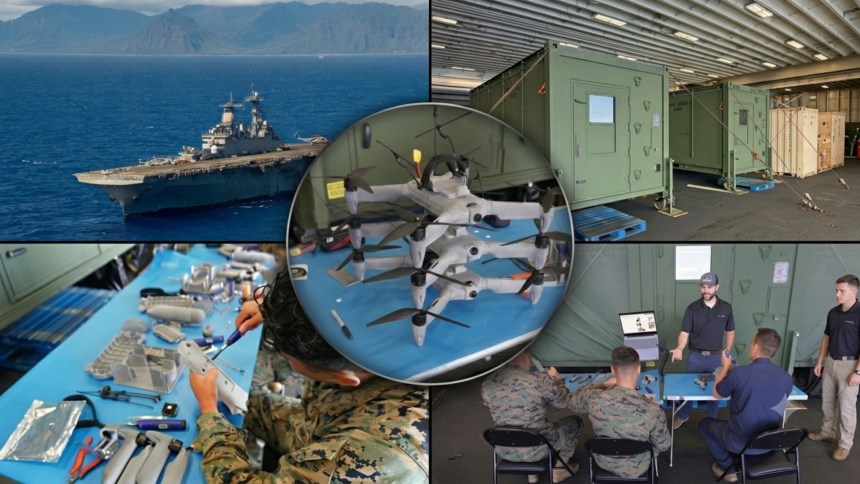
For the first time, a warship became a floating drone factory. Firestorm Labs manufactured 12 Squall first-person view drones aboard the USS Essex during a two-week trial as the amphibious assault ship steamed from San Diego to Hawaii for RIMPAC 2026. The build didn’t happen in a shore-based hangar or a distant lab — it happened underway, on a moving ship, in open water.
The magic sits inside a shipping container. Firestorm’s xCell containerized microfactory turns a standard steel box into a self-contained additive-manufacturing line, spitting out airframes on demand. Load the raw material, feed in the design files, and the container does the rest. Instead of ordering drones, waiting on logistics chains and hoping the right parts survive the journey across an ocean, a crew can now conjure fresh aircraft where and when they’re needed.
The Squall itself is an FPV drone — the same lineage of small, agile, camera-piloted quadcopters that has rewritten the rules of modern conflict. Cheap to produce, easy to swarm and effectively expendable, FPV drones trade sophistication for sheer numbers. Being able to churn them out at sea leans hard into that logic.
These 12 weren’t built for a display case. Once the fleet reached Hawaii, the freshly printed Squalls were flown as opposing aircraft during a counter-drone exercise at RIMPAC 2026, acting as the aggressor swarm that defenders had to detect and neutralize. That’s a meaningful detail: the aircraft weren’t just assembled to prove they could be — they went straight into a live scenario and did a real job.
The implications ripple outward. Traditional military supply chains are slow, fragile and painfully visible. A container that manufactures drones on the move flips that model on its head. A ship no longer needs to carry every airframe it might use; it carries the means to make them. Damaged or destroyed units can be replaced overnight. Designs can be revised between voyages — or between missions — as tactics evolve.
There are limits worth keeping honest about. This was a demonstration completed in late July 2026, not a proven doctrine. Twelve drones over two weeks is a proof of concept, not an assembly line running at industrial scale. Questions about material stockpiles, power draw, maintenance and quality control at sea all remain open. And an FPV drone printed on a rolling deck faces the same environmental headaches — vibration, humidity, salt — that make shipboard engineering hard.
Still, the direction is unmistakable. Manufacturing has traditionally been something that happens far from the fight and gets shipped forward. Firestorm just collapsed that distance to zero. Whether the future battlefield is defined by who has the most drones or by who can make them fastest, this trial nudged the answer toward the latter.