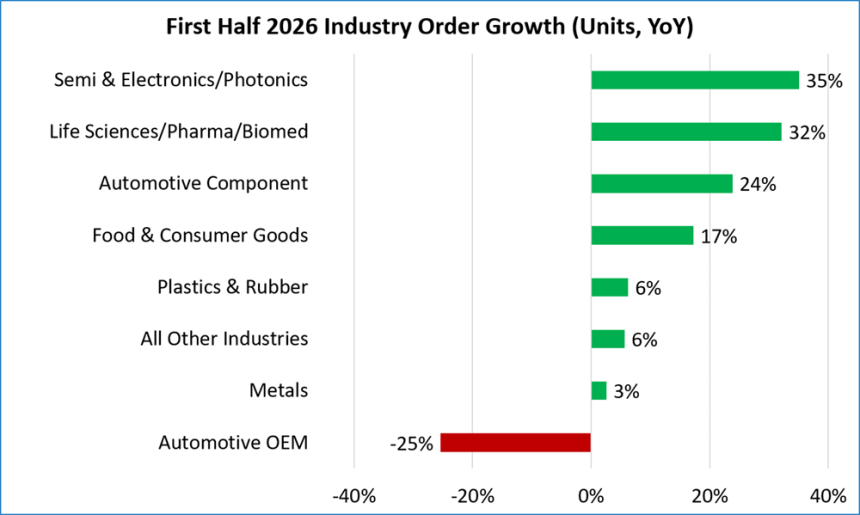
The robot business is broadening out. According to the Association for Advancing Automation (A3), robotics orders rose across multiple industries in the second quarter of 2026, with strong demand from food, electronics, and healthcare making up for a slowdown in the sector that has traditionally carried the market: automotive.
For years, car and component manufacturing has been the beating heart of industrial robotics in North America. Assembly lines bristling with articulated arms spot-welding, painting, and lifting have long defined what the public pictures when it hears the word ‘robot.’ So when that segment cools, it usually drags the whole market down with it. This quarter, that didn’t happen.
Instead, A3 credits a spread of demand into industries that historically lagged behind automotive when it came to automation. Three stood out:
- Food — packaging, palletizing, and handling tasks where hygiene, speed, and labor shortages are pushing companies toward automation.
- Electronics — precision assembly and inspection work, a natural fit for robots as component sizes shrink and volumes climb.
- Healthcare — a growing appetite for automation in labs, logistics, and adjacent medical manufacturing.
The takeaway is less about a single blockbuster quarter and more about resilience. A robotics market that leans on one industry is fragile; a market with demand distributed across food processors, electronics makers, and healthcare firms is far harder to knock off balance. When automotive orders soften — as they did in Q2 2026 — the other verticals can quietly keep the numbers pointing in the right direction.
It also hints at where the next wave of automation is heading. The industries showing growth here tend to face the same pressures: persistent labor shortages, rising throughput expectations, and tasks that are repetitive, precise, or simply unpleasant for humans to do all day. Robots slot neatly into that gap, and the falling cost and rising flexibility of modern systems make them viable in places that couldn’t justify the investment a decade ago.
For manufacturers and integrators, the message from A3’s quarterly snapshot is encouraging: diversification is real, and it’s cushioning the market against the ups and downs of any single sector. Whether the automotive slump proves temporary or signals a longer transition — think retooling for electric vehicles and shifting production strategies — the broader robotics industry appears to have found new legs to stand on.
If Q2 2026 is any indication, the future of automation won’t be written on the car assembly line alone. It’ll be built in food plants, electronics factories, and hospitals too.