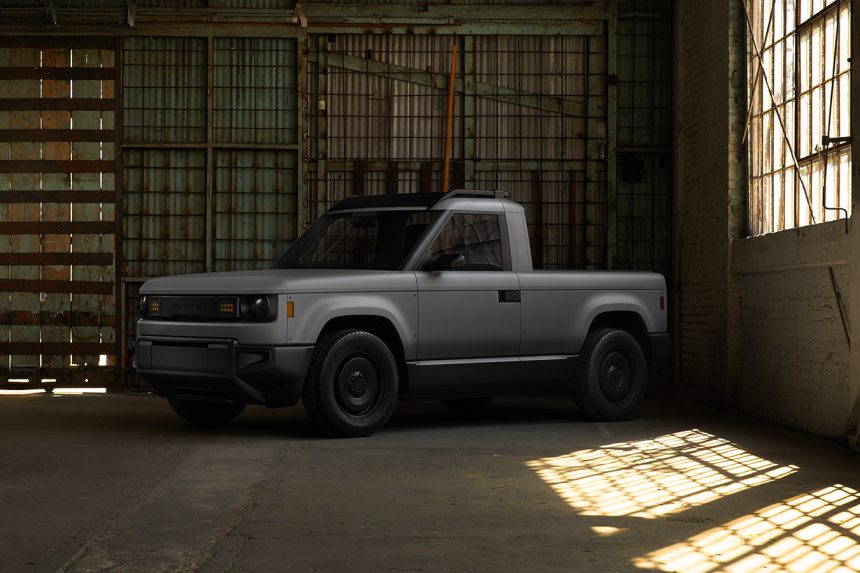
The car industry has spent decades chasing the same look: giant grilles, towering hoods, aggressive stances that seem engineered to intimidate the vehicle in front. The Slate Truck throws that entire playbook out — and according to its head of design, Tisha Johnson, that’s precisely why people can’t stop talking about it.
Johnson is a rare figure in automotive design: a woman running the entire aesthetic show, not just interiors and color palettes. Her approach to Slate’s Jeff Bezos–backed electric pickup was refreshingly blunt. “We didn’t want it to be a jerk,” she told WIRED‘s Jeremy White. “We rejected an aggressive, hyper-dominant look. We didn’t want it to look like a beast on the road.”
Instead, the design brief centered on one word the team quietly baked into every decision: love. That meant round headlamps with an “eyes wide open” alertness, a strong shoulder line signaling safety, and a fairly upright windscreen rather than a swoopy, fast-looking profile. Even the front badge plate — traditionally sacred, untouchable design DNA — was reimagined with exposed fasteners so owners can pop it off and 3D-print their own replacement.
That democratic streak runs through the whole vehicle. Complete color changes are possible in two days for around US$500, panels can be swapped, and decals, roof racks and grille plates are available from Slate. The company is also publishing a stack of its 3D files so owners can tweak and print their own parts.
Then there’s the price. Starting at US$24,950 for the pickup and US$29,950 for the SUV configuration, the Slate isn’t just the cheapest EV on the US market — it undercuts every pickup regardless of powertrain. But Johnson is adamant that cheap alone doesn’t earn affection; cheap usually means compromise. The trick was making something both beautiful and accessible.
The engineering reflects the same restraint. The Slate runs a 65-kWh LFP battery rated at 205 miles of range, driven by a single rear motor producing 181 horsepower and 195 pound-feet of torque, good for roughly an eight-second zero-to-60. Payload is 1,550 pounds and towing capacity 2,000 pounds.
Where rival EVs pile on ludicrous acceleration and wall-to-wall touchscreens, Slate strips the tech bloat. The team debated whether an HVAC unit was even necessary. A cost analysis pitted a manual window crank against a power pack — and the crank won. The integrated stereo, notably, did not make the cut.
The result of all that discipline is a vehicle that transforms from pickup to “squareback” SUV to jeep-like “fastback” thanks to a genuinely modular design. Revealed on April 24, 2025, the Slate Truck has racked up 180,000 preorders and counting, with reservations open on a fully refundable US$300 deposit. First customer deliveries are set for the fourth quarter of 2026.
“Love is so much more stable,” Johnson says. “And lasts longer.”