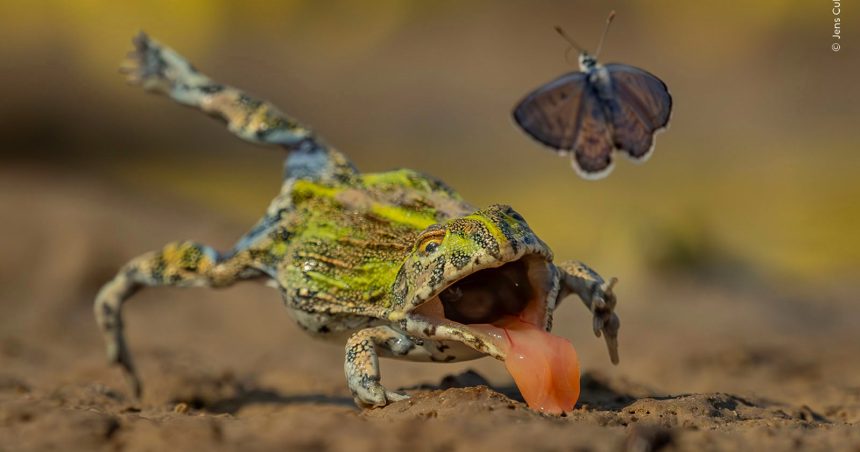
A butterfly’s split-second dodge from a lunging African bullfrog. A low-flying swift lining up in eerie parallel with a jet inbound to Heathrow. A muzzled brown bear pedalling a motorcycle in a Doha circus. These are just three of the images the Natural History Museum has revealed in an early look at 15 finalists for its Wildlife Photographer of the Year 2026 competition.
For photographers, this contest remains the ultimate proving ground — a reminder that technical mastery means little without patience, timing, and a story worth telling. This year’s shortlist was distilled from more than 65,000 entries, with 100 images making the final cut. Judging was done anonymously by an international panel drawn from wildlife photography, filmmaking, science and conservation, weighing each frame on creativity, originality, technical excellence and narrative power.
The selection spans an impressive range of disciplines and conditions, showcasing the kind of gear-and-grit combination that defines the genre:
- Behavior shots that demand fast reflexes and faster shutter speeds — the babul butterfly escaping a bullfrog in Botswana, and a young leopard chasing a squirrel up a tree in the Okavango Delta.
- Environmental portraits pushing hardware to its limits, like a chameleon riding out a sandstorm in the Namib Desert.
- Macro work requiring razor-thin focus, including a 15-millimeter (0.6 inch) lichen dragon katydid in Ecuador’s Andes, and a mosquito feeding on a viper’s blood.
- Underwater frames such as a school of bigeye trevally in the Seychelles and a sea hare gliding through an eelgrass meadow in Monterey Bay.
- Urban wildlife that captures the collision of nature and civilization — a black bear cooling off in a southern California pool, and an Eastern Japanese toad crossing a rain-slicked Tokyo street.
Some entries carry a heavier emotional weight, like an adult orca carrying a deceased calf off the coast of Norway, or a black vulture perched on the carcass of a yacare caiman in Brazil’s Pantanal wetlands. Others reward sheer persistence, such as an oxpecker cleaning its bill against a rhino’s skin in golden South African light, and a flock of birds descending on a waterhole in Kenya’s Tsavo East National Park.
Notably, two of the standout images came from young photographers, highlighted in the 11-14 and 15-17 Years categories — proof that a compelling eye doesn’t wait for a full-frame budget.
The category winners, along with the coveted Grand Title and Young Grand Title awards, are due to be announced on Tuesday, October 13, 2026 at a ceremony hosted at the Natural History Museum in London, streamed live on the museum’s YouTube channel. The winning collection then goes on public display in an exhibition opening Friday, October 16, 2026.