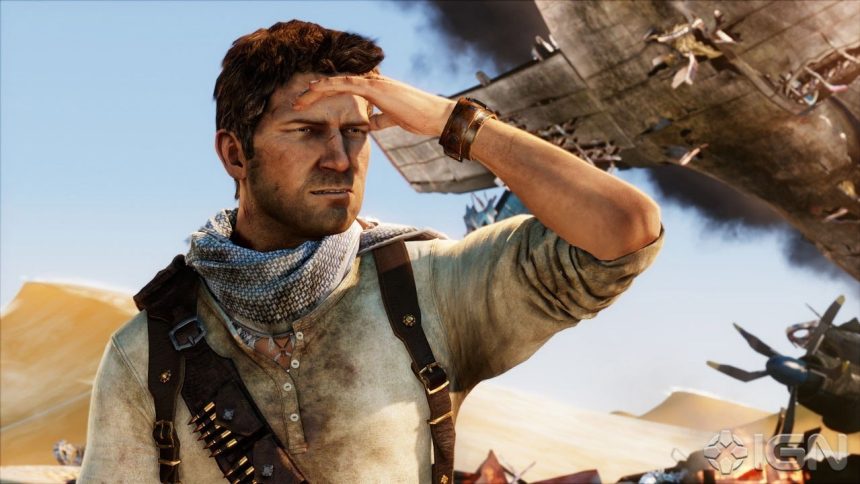
Few PlayStation games have ever felt as cinematic as Uncharted 3: Drake’s Deception, with its collapsing cruise ships, burning chateaus and that unforgettable cargo plane sequence. But according to a former Naughty Dog designer, all that spectacle came at a cost — and the roots of the problem trace back to the runaway success of its predecessor.
Benson Russell, who worked as a designer on both the Uncharted series and The Last of Us, has argued that Uncharted 2: Among Thieves may have unintentionally shaped the development of the third entry for the worse. His verdict is blunt: “I think that was a big flaw.”
The issue, as Russell frames it, was an over-reliance on set pieces. Uncharted 2 earned near-universal acclaim, and one of its most celebrated moments — the escape from a derailing train — set a new bar for scripted, high-adrenaline action in a third-person adventure. The trouble is that a single spectacular moment is easy to admire, but a whole game built to chain such moments together is a very different design challenge.
When a studio scores a hit, the temptation is to double down on whatever earned the praise. For Uncharted 3, that meant stacking set piece after set piece, each engineered to top the last. The result is a game that dazzles in individual scenes but can feel, at times, like a sequence of theme-park rides bolted together rather than a coherent, player-driven journey.
It’s a reflection that lands differently in hindsight. At launch, Uncharted 3 was widely praised and remains a technical showcase for its era on PlayStation hardware. Yet the tension Russell identifies — between authored spectacle and genuine player agency — is one the entire industry has wrestled with ever since. Games that lean too hard into scripted moments risk turning the player into a passenger.
What makes the comment interesting is the source. Naughty Dog eventually became known for tightening that balance, and later titles leaned more heavily on character, pacing and emotional weight rather than sheer set piece density. In that sense, the lessons of Uncharted 3 arguably fed directly into the studio’s later, more restrained work.
Russell’s point isn’t that spectacle is bad — the Uncharted series would be unrecognizable without it. It’s that success can become a creative trap, pushing a team to chase the same highs instead of asking what the next game actually needs. For a franchise that redefined the cinematic action-adventure, admitting that the formula had a flaw is a surprisingly candid bit of postmortem honesty.
For fans revisiting the trilogy today, it’s worth playing Uncharted 3 with that lens in mind. The seams between its showstopping moments are easier to spot once you’re looking for them — and they tell a quiet story about the pressures of following up a masterpiece.