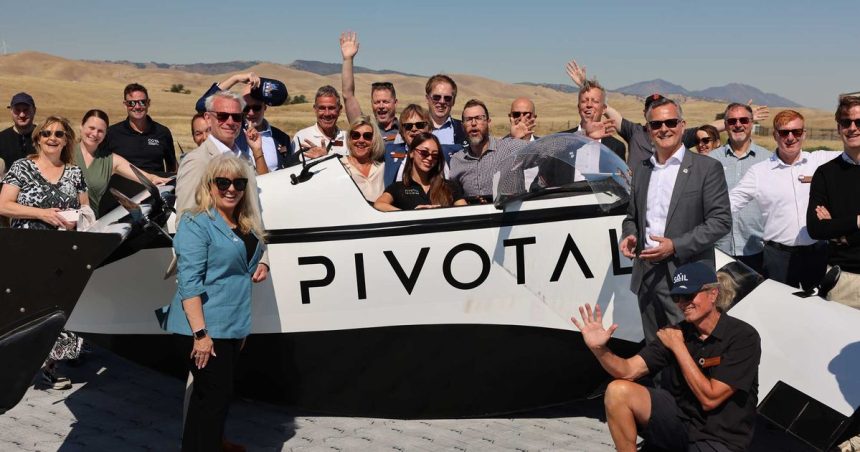
The company trying to put a personal flying machine in your garage just changed its pilot. Pivotal, the Palo Alto eVTOL outfit backed by Google co-founder Larry Page, has parted ways with CEO Ken Karklin after more than four years at the controls. The company says he is “pursuing new endeavors,” which is corporate shorthand that leaves the interesting details firmly on the ground.
Stepping in on an interim basis is Mike Ross, an aviation executive who joined Pivotal’s board back in November 2025. He inherits a company that has already crossed the awkward threshold between demo reels and actual flight. “This industry has moved past prototypes and press releases,” Karklin said on his way out — a fitting epitaph for a sector that has spent a decade promising the sky.
The headline product is Helix, Pivotal’s single-seat electric vertical takeoff and landing aircraft. Its most disarming feature isn’t the specs — it’s the paperwork. Because Helix qualifies as an ultralight, you don’t need a pilot’s license to fly one. That accessibility is the whole pitch, and it’s priced accordingly steep: reservations open at US$190,000, with a $50,000 deposit and delivery quoted at nine to twelve months. Buyers can also tack on a transport trailer for $21,000 and a charger for $1,100.
Ross is already talking about the next step: a fourth-generation Helix aircraft, which he flagged as the company’s near-term target. He praised what he called Pivotal’s “disciplined approach to safety, engineering, and accessibility” — the kind of language you deploy when you want reservation holders to keep their deposits parked.
The other half of the story is BlackFly, Pivotal’s aircraft aimed at defense and first-responder work. It graduated from theory to genuine field use recently, when it responded to an emergency in North Carolina for the first time. According to Pivotal, BlackFly reached the scene 20 minutes ahead of an ambulance dispatched to the same call. The company says its BlackFly platform has now logged more than 10,000 flights, which is a meaningful number in an industry where most competitors count their trips in the dozens.
Pivotal is also one of the firms selected for the FAA’s eVTOL Integration Pilot Program, the regulatory sandbox created to expand real-world testing of these aircraft across the country. That matters, because the gap between a working ultralight and a legally accepted mode of personal transport is measured less in engineering and more in bureaucracy.
A CEO change is rarely a good look for a hardware startup asking customers to wire six-figure deposits. But Pivotal’s line is continuity: the team, priorities and roadmap, Ross insists, “remain steady through this transition.” With aircraft already in the air and buyers already in the queue, that steadiness is the most valuable thing the company owns.