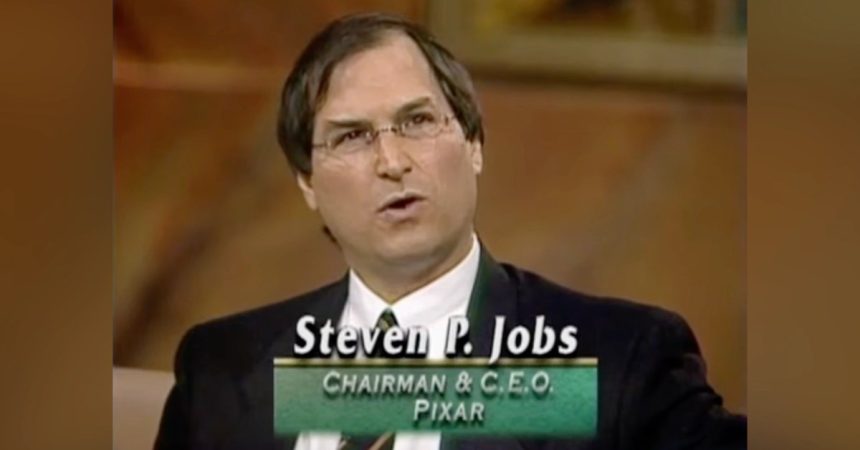
Long before the iPod, the iPhone, or a market cap that would make it the most valuable company on Earth, Steve Jobs made a bet on Apple’s survival — and a vintage clip that recently resurfaced captures that moment with startling clarity.
The footage comes from an interview on Maryland Public Television’s Wall Street Week with Louis Rukeyser, filmed in 1996. At that point Jobs had not yet returned to the company he co-founded. Apple was floundering, and the industry chatter leaned heavily toward doom. Jobs, characteristically, saw a different route.
“I still think Apple has a future,” he insisted — and then laid out the philosophy that would define his second act.
The heart of the interview is a single, now-famous line about how Apple could claw its way back from the brink:
“I think the way out is not to slash and burn. It’s to innovate. That’s how Apple got to its glory, and I think that’s how Apple could return to it.”
Read three decades later, it lands less like optimism and more like a roadmap. Jobs rejected the standard turnaround playbook of cost-cutting and retrenchment in favor of building things people didn’t yet know they wanted. History did the rest — for Apple, and for Pixar, whose Toy Story was reshaping animated cinema around the same time.
What makes the clip so compelling isn’t nostalgia. It’s the contrast between the confidence in Jobs’s voice and the reality of the moment. In 1996, betting on Apple was a contrarian position bordering on the reckless. The company would flirt with collapse before Jobs came back and steered it toward the product-driven strategy he described here almost casually.
The timing of the video’s return to circulation is hard to ignore, too. It surfaced just as Apple installed a new CEO, offering an accidental but pointed piece of perspective on how the company handled leadership and direction in far darker times. Every succession invites comparisons, and this one arrives with a reminder baked in: Apple’s most decisive turnaround was powered not by austerity but by ambition.
Credit for surfacing the moment goes to Patrick McGee, and it’s worth the few minutes for anyone who has followed Apple through its many acts. The words are simple, the delivery unhurried, and the man saying them had no way of knowing just how right he’d be.
Innovation over slash-and-burn. Three words that outlasted the crisis they were meant to answer.