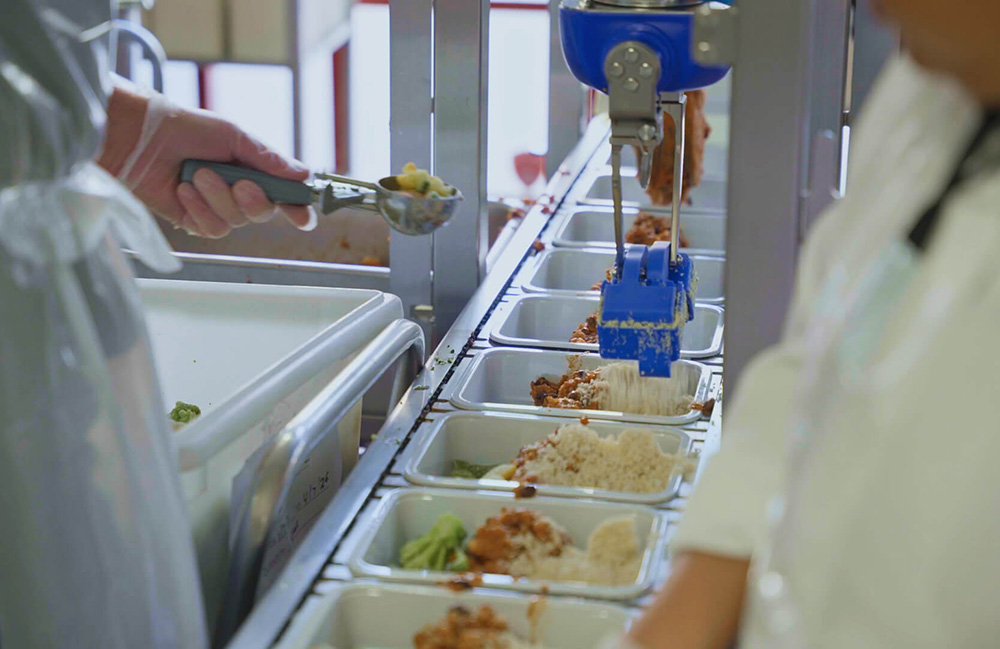
Robots can weld car bodies all day, but ask one to scoop mashed sweet potato onto a tray without mangling it and things get complicated fast. That, in a nutshell, is the argument Rajat Bhageria, founder and CEO of Chef Robotics, will bring to RoboBusiness 2026, which runs Oct. 20 and 21 at the Santa Clara Convention Center in Santa Clara, Calif. His talk carries a suitably bold name: “Why Food is Physical AI’s Hardest Problem and Most Promising Catalyst.”
The case for food as robotics’ ultimate stress test is straightforward. A machined part is identical every time; a chicken thigh, a ladle of curry or a handful of shredded cheese is not. Bhageria’s session will dig into the sensor-fusion challenges of grasping soft, deformable objects, the force-control precision needed to handle fragile materials without crushing them, and why real-world training data — not simulation alone — is essential for building robotic policies that survive contact with an actual production line.
Chef Robotics has earned the right to lecture on the subject. The San Francisco-based company says its machines have completed over 118 million servings in production across over a dozen food manufacturing facilities in North America and Europe. Along the way it has amassed what it calls the largest real-world dataset of deformable material manipulation, which now feeds its Food Foundation Model (FFM) — an AI model that lets robots generalize to new ingredients with minimal retraining, rather than being painstakingly reprogrammed for every recipe change.
The commercial wrapper around all this is ChefOS, the company’s physical AI operating system, delivered under a Robotics-as-a-Service model that bundles the hardware with software updates, maintenance and 24/7 monitoring. Customers include Amy’s Kitchen, CookUnity and Apetito, and Chef Robotics claims deployments have delivered a 2-3x output increase and an 88% reduction in giveaway — the industry term for expensive over-portioning.
The stage suits the message. RoboBusiness, now marking its 20th anniversary, expects more than 1,600 attendees and will pack over 40 sessions into 5 conference tracks, with 11 keynote speakers announced so far — including robotics luminaries Rodney Brooks and Ken Goldberg. Attendees can also work the room at the Mix and Mingle reception on the first day of the show.
Whether food really is physical AI’s hardest problem is debatable — surgeons and warehouse pickers might object. But as a proving ground where messy reality meets machine learning at industrial scale, a production line slinging its 118-millionth serving makes a compelling exhibit A.