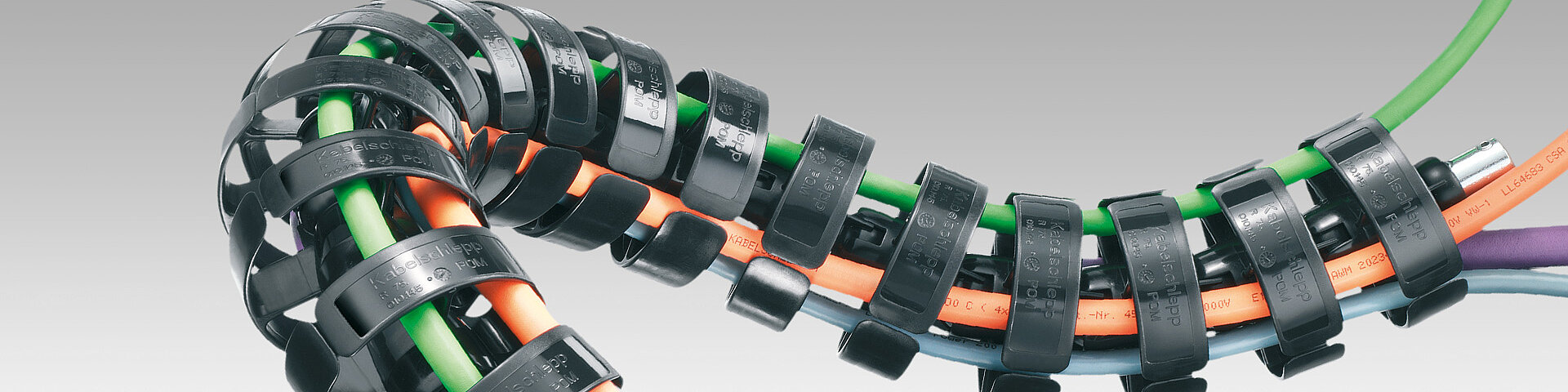
Cables are the quiet casualty of industrial automation. Every time a six-axis robot arm swivels, rotates, and extends, the electrical cables, fiber optics, and pneumatic hoses feeding it absorb torsional twist, rapid acceleration, and repeated knocks against the machine’s own structure. The outcome is familiar to any plant engineer: conductor fatigue, insulation breakdown, and unplanned production stops. Tsubaki KabelSchlepp’s Robotrax System attacks the problem with a cable carrier designed from the ground up for three-dimensional robotic motion.
The core idea is deceptively simple. A steel cable runs through the center of every chain link, and when the robot arm accelerates — the system is rated for accelerations of up to 10 g — that steel core absorbs the primary tensile loads instead of the wiring. With electrical and fluid lines isolated from pulling forces, cable service life stretches dramatically. An integrated clamping piece lets mechanics calibrate and adjust system tension for consistent mechanical support over long operational cycles.
Mechanically, the carrier is built from open, single-piece plastic links with spherical snap-on connections on both sides, so the chain flexes smoothly across three axes and delivers radial rotation of up to ±450 degrees per meter, depending on the model size. Inside, up to three separate chambers keep heavy power lines, sensitive data channels, and fluid hoses from abrading each other or trading interference. On the standard models — R040 through R100 — technicians simply press cables into the open carrier without tools, cutting installation and maintenance time. The larger R140X adds swiveling crossbars with snap locks plus vertical and horizontal dividers for customized interior partitioning.
Fast robots with large work envelopes bring another hazard: loose carrier loops swinging around and striking the robot body. Tsubaki KabelSchlepp counters with the Pull Back Unit (PBU), an active retraction mechanism that keeps the carrier under optimal tension through the entire motion cycle, eliminating excess slack and interfering contours. The retraction element requires zero maintenance, and the unit comes in standard mounting configurations for KUKA, ABB, and FANUC robot platforms.
For harsh environments, the system takes on armor:
- Protectors — impact shields retrofitted onto individual chain links that limit the minimum bending radius and take the brunt of external abrasion; a worn module is replaced on its own instead of swapping the entire carrier assembly.
- Heat shields — aluminum-coated textile fiber covers against radiated heat, hot weld spatter, and flying sparks.
- Protective covers — coated polyester sleeves that shield sensitive lines from aggressive cutting fluids, hydraulic oils, paint overspray, and abrasive dust.
- LineFix strain relief — multi-layer clamps that anchor cables at both ends to prevent axial displacement during intense motion.
From automotive welding cells to high-speed machining centers, the pitch to plant engineers and system integrators is straightforward: absorb the loads centrally, flex in all three axes, and keep the slack in check — so the robot keeps running instead of waiting on a cable repair.