Seven-year contracts are rare in a business where most autonomy pilots quietly expire after two semesters. Robot.com — the San Francisco company that traded the name Kiwibot for a domain in October 2025 — has one, and it is with Sodexo Group. The commercial agreement, announced on August 20, 2026, expands autonomous delivery across select Sodexo-operated college campuses in North America and is the largest single enterprise deployment in the company’s history.
The two sides have been working together since 2021, and that history is the whole story. “Seven-year contracts don’t come right away,” said Robot.com co-founder and CEO Felipe Chavez Cortes. “It was a learning process for both companies on what it takes to implement robotics, and what it takes to add value on both sides.”
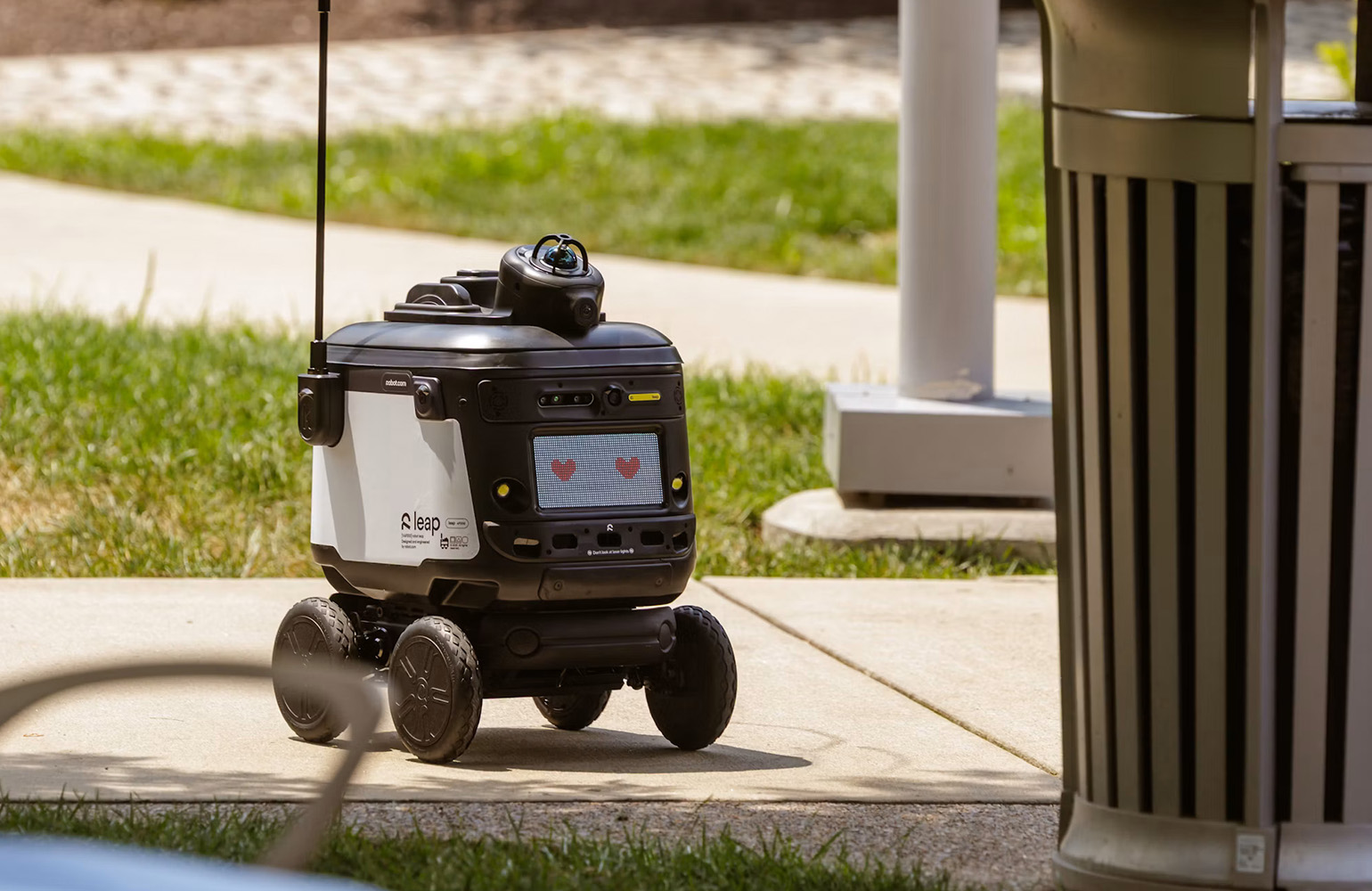
The machine doing the walking is the R-Kiwi, a small sidewalk box that has quietly piled up mileage: more than 500 units deployed, and 2.4 million tasks completed across campuses and city sidewalks. Robot.com lists its specs as:
- Level 4 autonomy
- 10-12h battery life
- 19-liter cargo capacity
- Six HD cameras plus NVIDIA-powered superwide-angle 3D LiDAR
- Real-time navigation and an available wireless charging system
Campuses are not a consolation prize for a company that cannot crack downtown — they are a deliberate proving ground. “I do feel that college campuses are a very good staging environment,” Cortes explained. “You’re outside. You have people, but it’s not as crazy as urban.” Pedestrians, weather and curbs, without the chaos of a city intersection.
The less visible half of the product is Remi, the company’s robot implementation intelligence platform, which combines classical robotics with third-party software and advertising technology. “Remi is our robot implementation intelligence, and it’s a product and platform that we have been developing for almost a decade,” Cortes said. “When we implement Remi, we basically get better economics on the costs of implementing the robots.” Robot.com has also partnered with Field AI and Physical Intelligence on safety assurance for new deployments.
The metric the company actually watches is billable uptime. In the first half of the year it logged a quarter of a million hours generating revenue, and Cortes wants to reach a million hours per year.
Beyond the sidewalk box sit two more platforms. The R-Dog quadruped can drop packages, unlike other systems, and handle stairs or autonomous vehicles; it is due in 2027. The R-noid humanoid pairs a wheeled base with two arms and is aimed at kitchen assistance, packing lines, order picking and linen folding.
Sodexo’s side of the equation explains the appetite. The group serves 80 million consumers daily, employs roughly 400,000 people globally and 120,000 full-time staff in the United States. “Technology is most impactful when it enhances the everyday experience of the people we serve while enabling our teams to operate with greater agility,” said Roberta Frierson, VP of Digital, Campus at Sodexo North America.