Most optics companies start with a spreadsheet of MTF curves. Adapted Optics started with a cheap point-and-shoot, a set of tools and a photographer who had stopped enjoying his own gear.
That photographer is Thomas Spicher, a graphic design graduate who went looking for character in old cameras and ended up manufacturing it. His first experiment was pulling apart a Kodak VR35 K12 and grafting its optic onto a mirrorless body. “The Kodak VR35 K12 was the very first camera that I decided to tear apart and adapt to my mirrorless camera,” he told PetaPixel. “I got really lucky because it had these little helical teeth and a brass ring.” Enough people asked him to build one for them that the side project turned into a company.
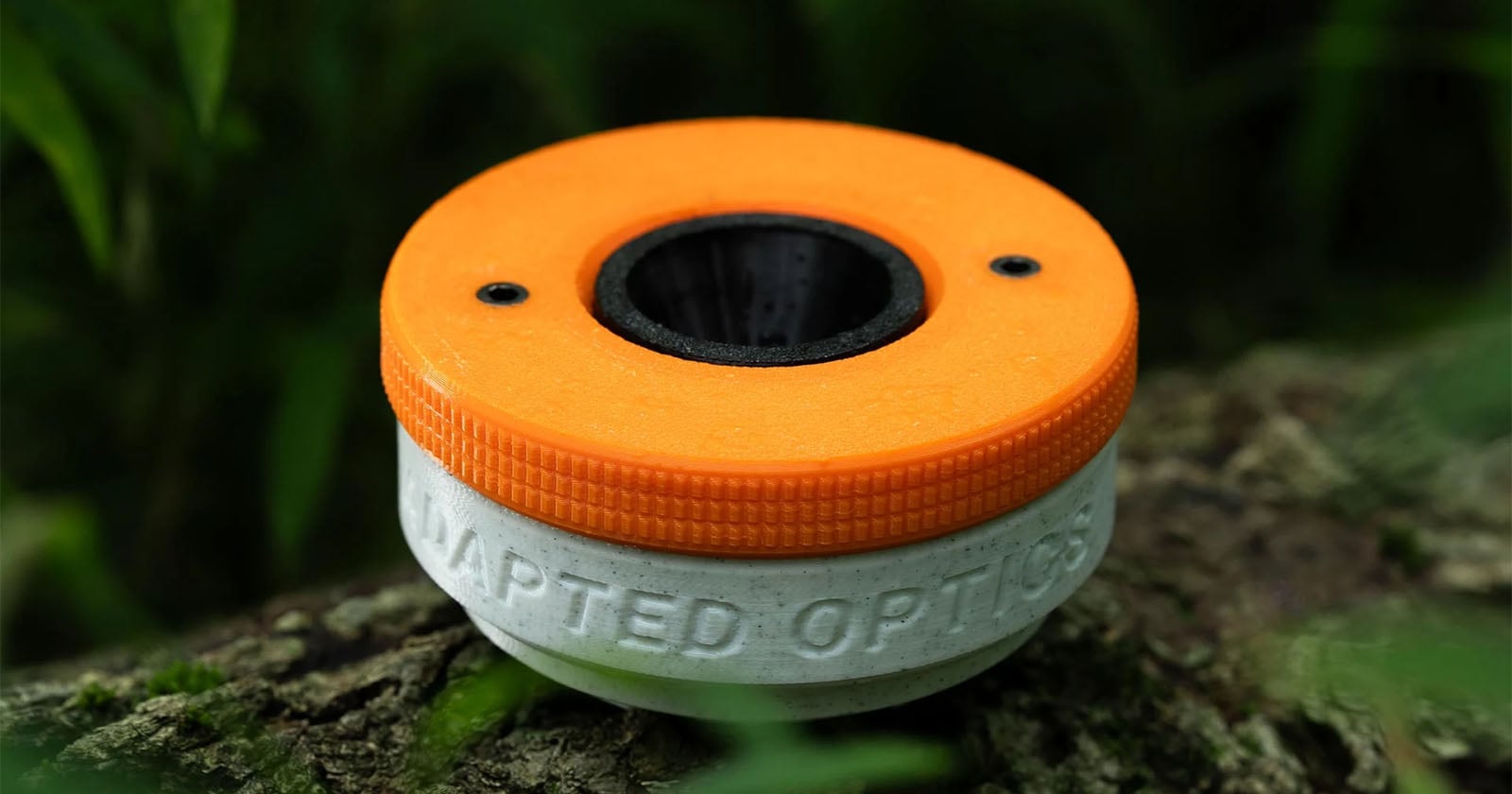
The result is the Everyday Lens, and the pitch is deliberately contrarian: turn a clinically sharp modern camera back into a disposable. The glass is genuinely salvaged — a very common element found in many disposable cameras, though Spicher will not say which one — and everything around it is new. The barrel is 3D-printed, the focus travel is proper manual focus rather than a wobbly hack, and the lens is built to reach infinity, which is exactly what the donor optic was never designed to do on a digital sensor.
Adapted Optics lists the Everyday Lens as a 32mm optic with a widest aperture of f/7. Instead of an iris, it uses interchangeable aperture discs, each with a job title attached:
- f/7 — open
- f/10 — everyday
- f/16 — control
- f/23 — motion
- a cross-shaped creative aperture for shaped highlights
Minimum focus distance is 10 inches (25.4 cm). Mount coverage is unusually broad for a one-person operation: Sony E, Canon RF, Nikon Z, L-Mount, Fujifilm X and Micro Four Thirds.
The customization is the other half of the product. Buyers choose the focus ring texture, the colors and the mount, so no two units have to look alike. There is also a cinema version fitted with industry-standard mod gears, which lets it sit in a follow-focus rig alongside lenses that cost a hundred times as much — a genuinely funny image, and a practical one for anyone chasing a lo-fi look on a controlled set.
Scale is the catch. The first production run is capped at 50 lenses, each built to order to the customer’s specifications. As of September 2026, preorders had not opened and Adapted Optics had not published a price; the company is collecting sign-ups on its site for a launch notification.
Plenty of people have adapted a dispo lens in their garage. What makes this one interesting is the refusal to treat it as a joke: the optic is a toy, the hardware around it is not.