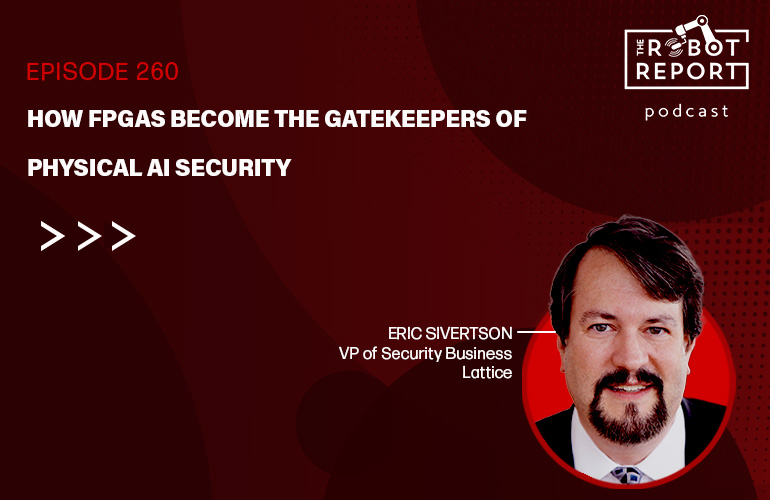
A modern robot is a computer with actuators, and it inherits every weakness of the software stack feeding it — over-the-air firmware, cloud-issued instructions, third-party AI models. Episode 260 of The Robot Report Podcast, published on September 4, 2026, hands that problem to someone who sells silicon for it.
The guest is Eric Sivertson, vice president of the security business at Lattice Semiconductor. The episode’s framing is blunt: FPGAs — field-programmable gate arrays — can act as deterministic guardrails for robotic systems. The show covers FPGAs, physical AI, and building safe and secure robots, with the interview starting at the 24:13 mark, after the news segment at 8:24.
The load-bearing word there is “deterministic.” A robot foundation model is a probability distribution wearing a trench coat — brilliant, opaque, and impossible to certify line by line. Programmable logic is the opposite: a bitstream does the same thing on cycle one and cycle one billion. Drop a small FPGA between the AI planner and the parts of the machine that can hurt someone, and you get a component whose behavior can actually be reasoned about, plus a place to anchor trust that is separate from the application processor running the clever bits.
Sivertson is not a newcomer to that argument. He has more than 30 years of experience developing technologies that enhance trust and security in embedded systems, wireless connectivity, and high-performance, reconfigurable computing, and he runs the security business for Hillsboro, Ore.-based Lattice.
That business has had a loud 2026. On April 2, 2026, Lattice announced wins at the 2026 Cybersecurity Excellence Awards. The Lattice MachXO5-NX TDQ FPGA family took the Post-Quantum Cryptography (PQC) category, cited as the industry’s first FPGA family delivering CNSA-2.0 compliant PQC, crypto agility, and a hardware Root of Trust. The Lattice Cyber Resilience Program won the Best Cybersecurity Awareness Program category. “From post-quantum capable hardware security features and solutions, we are focused on helping customers strengthen resilience across the system lifecycle,” Sivertson said in that announcement.
Before that, on February 18, 2026, Lattice and SEALSQ announced a collaboration to integrate TPM-based post-quantum security — SEALSQ’s QS7001 and QVault TPM — into select Lattice FPGA platforms. A proof-of-concept demonstration was shown at Embedded World 2026 in Nuremberg, Germany, held March 10-12, 2026, at Lattice’s Hall 4, Booth #528.
The post-quantum angle sounds abstract until you think in fleet lifetimes. Industrial robots and farm machinery stay in service for well over a decade, so a machine validating signed firmware in 2026 needs a signature scheme that still holds up long after the cryptography it shipped with has aged out. Swapping the algorithm in reconfigurable logic is a rather different proposition from swapping a hard-wired crypto block.
Episode 260 also ran through its news segment, covering:
- Deere’s new AI-driven features in Operations Center, JD
- NVIDIA’s plan to acquire Hugging Face and keep the AI development platform open
- Skild AI unveiling its S1 flagship robot foundation model
- An update on the Teradyne Robotics/JAKA Robotics lawsuit