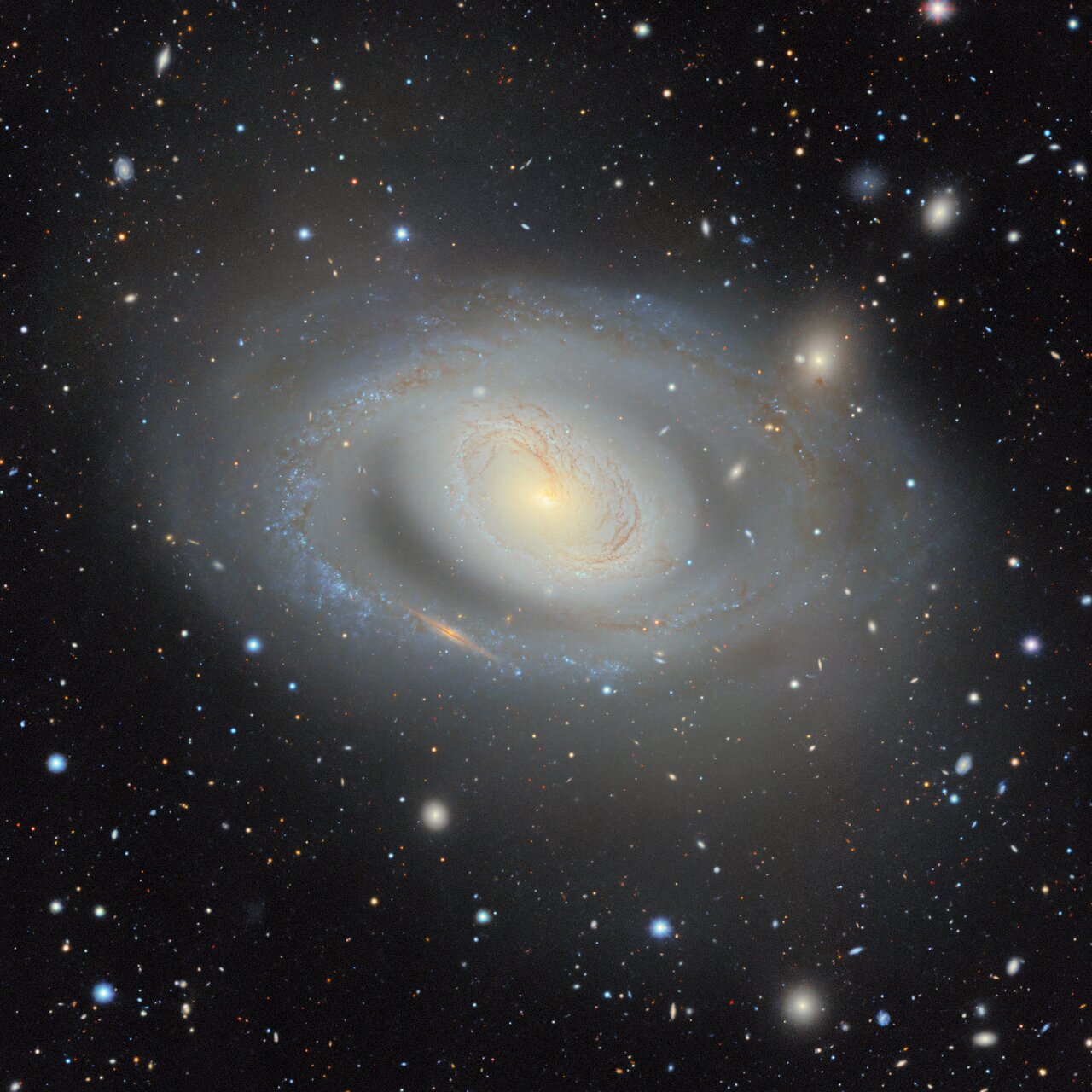
A browser tab now doubles as a fairly serious telescope. The DESI Legacy Imaging Surveys team has published DR11, its eleventh data release and the largest two-dimensional map of the universe ever assembled: 5.6 trillion pixels holding nearly 4 billion celestial objects — stars, galaxies, black holes and asteroids. It went public on August 10, 2026, and it is free to pan around through the Legacy Survey Sky Viewer at viewer.legacysurvey.org.
The map covers roughly 75 percent of the sky in visible and near-infrared light, and it was 13 years in the making. Nothing about that is a single heroic exposure — it is a mosaic stitched from an industrial quantity of observing time.
- Scale: 5.6 trillion pixels, nearly 4 billion catalogued objects
- Coverage: roughly 75 percent of the sky, visible plus near-infrared
- Raw material: 263,407 telescope exposures across 2,285 observing nights
- Hardware: the Víctor M. Blanco 4-meter Telescope at Cerro Tololo with the 570-megapixel Dark Energy Camera, the Mayall Telescope at Kitt Peak, the Beijing-Arizona Sky Survey run from Steward Observatory, and infrared data from NASA’s WISE satellite
- Processing: about a year to write the code, then eight weeks of crunching on the Perlmutter supercomputer at NERSC
- People: more than 160 scientists contributed; over 1,800 published papers already reference Legacy Surveys data
Why only three quarters of the sky? Because our own galaxy is in the way. The Milky Way is splayed out like a fried egg, which is why it reads as a dense band of stars overhead, so the surveys point up out of the galactic disc or down through it to get the cleanest view of deep space.
The imaging is not an end in itself — it is the shopping list. Since June 2026, the new map has been used to pick targets for the Dark Energy Spectroscopic Instrument, whose 5,000 robotic fibre positioners sit on a mountain in Arizona’s Sonoran Desert and measure distances object by object. An earlier 2026 release plotted 47 million galaxies and quasars, reconstructing 11 billion years of cosmic history. Data from DESI’s first three years, combined with supernova observations and the leftover radiation from the Big Bang, hinted that dark energy may not be a constant at all but is gradually weakening.
DESI wrapped its five-year survey in April 2026, ahead of schedule; the full five-year analysis is due in 2027, and the instrument keeps observing through 2028.
“It’s part of the fabric of astronomy research now,” said David Schlegel, co-lead of the Legacy Surveys at Lawrence Berkeley National Laboratory. “When you’re working with astronomical objects today, you often start by pulling up the Legacy Imaging Viewer to see what you’re looking at.”
Co-lead Arjun Dey of NSF NOIRLab framed the public release more plainly: the skies belong to everyone, and the survey gives everyone the chance to marvel at their wonders. The data will also serve as a reference point for the Vera C. Rubin Observatory and NASA’s Nancy Grace Roman Space Telescope, while the team plans to train AI tools to dig through the petabyte-scale archive faster than humans can.