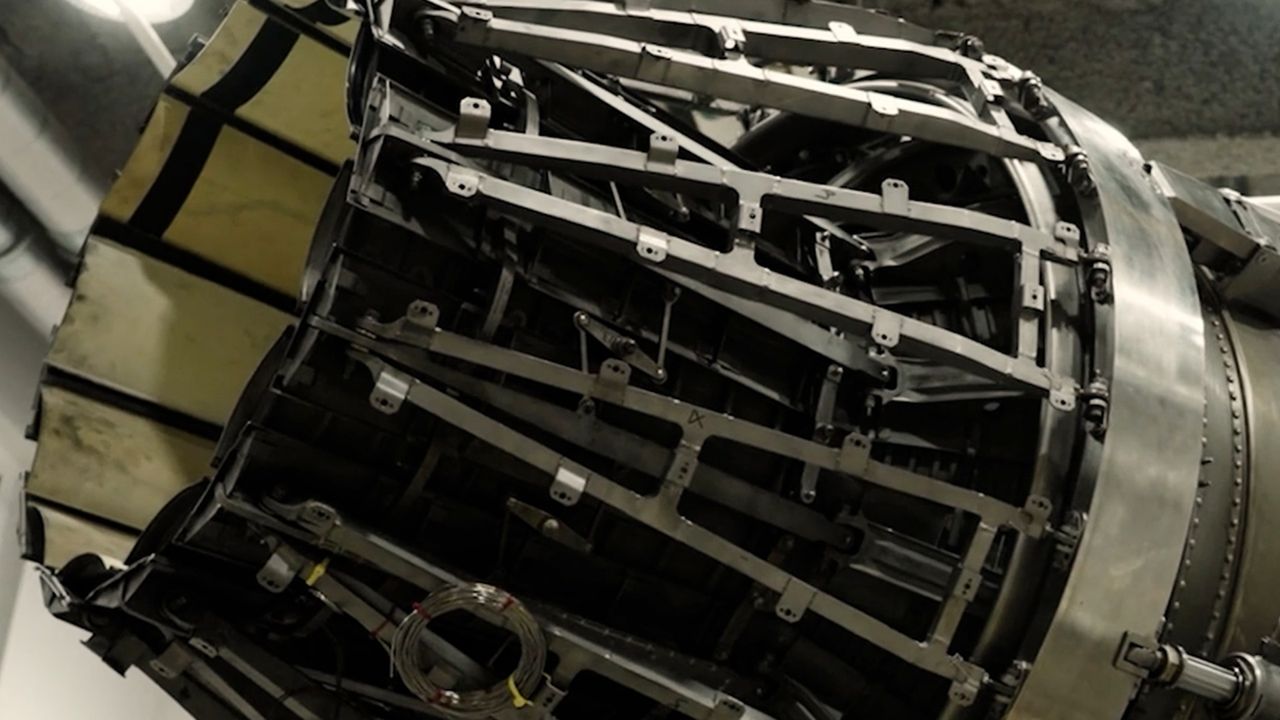
The hardest part of building an uncrewed fighter that takes off straight up turned out to be a piece of metal that had been sitting in a warehouse for about 30 years. Shield AI and GE Aerospace have pulled the Axisymmetric Vectoring Exhaust Nozzle (AVEN) out of storage, refurbished it and mated it to an F110-GE-129E engine to give the X-BAT autonomous jet its vertical takeoff and landing capability.
AVEN is not a new idea. GE developed and flew it in the 1990s on the F-16 Multi-Axis Thrust Vectoring testbed, where it logged 73 hours of ground testing and 135 flight hours across 95 flights, according to The Aviationist. It was never fielded operationally. Steve Russell of GE Edison Works told Defense One that after the demonstration campaign, “it basically went into storage” — and that is where it stayed until Shield AI needed a nozzle that could swivel a fighter-class exhaust plume toward the ground.
The revival has moved fast. GE Aerospace was selected for the X-BAT propulsion program in November 2025. On July 20, 2026, the two companies announced they had completed integration, actuation and engine light-off testing of AVEN on the F110-GE-129E at GE Aerospace’s test operations site in Peebles, Ohio, running coordinated nozzle movement sequences against defined test protocols. Shield AI says the original 1990s hardware survived largely intact; the software around it had to be rewritten.
Aviation Week reported on September 3, 2026 that GE Aerospace is shipping the AVEN nozzle to Shield AI for integration with the X-BAT after more than 100 hours of ground tests. The next milestone is a tethered vertical flight test before the end of 2026, with the aircraft suspended from a 180-foot crane and expected to hover steadily enough to put slack in the tether.
What the nozzle is lifting is unusual. X-BAT sits on its tail, launches vertically and needs no runway or airbase. Shield AI lists the following figures for the aircraft:
- Combat radius: 1,000 nautical miles
- Range: more than 2,000 NM
- Ceiling: above 50,000 ft
- Wingspan: 39 ft
- Internal payload: up to 2,000-pound class weapons in each bay
- Electrical power generation: 80 kilowatts
- Maneuver load factor: greater than 4g
- Stowed footprint: 40 ft x 14 ft x 6 ft
That last line matters as much as the thrust figures. An aircraft that folds into a box roughly the size of a shipping container and launches without a runway can operate from ships, clearings and improvised sites that a conventional fighter cannot touch.
“X-BAT is designed to take off and land vertically from anywhere — no airbase, no runway,” said Armor Harris, Shield AI’s senior vice president of aircraft engineering. Doogie Russell, vice president of Edison Works at GE Aerospace, framed the partnership as “integrating the best of past, present, and future products.”
The Aviationist reports the program targets full system flight testing and operational validation in 2028, with production launch in 2029. The engine and its resurrected nozzle are the part that had to work first.