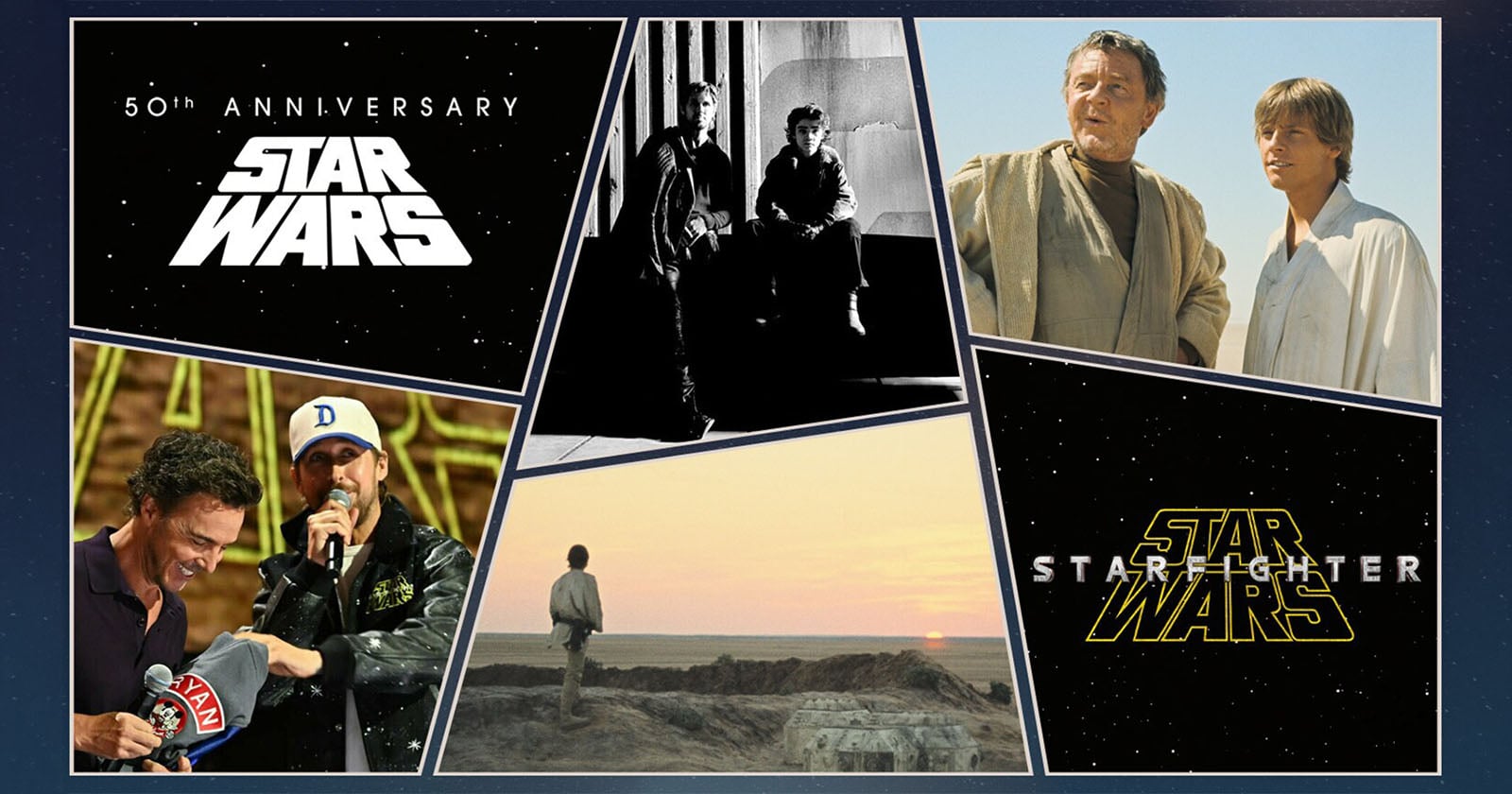
Five decades of Star Wars in cinemas, and not a single frame of it has ever run through an IMAX film projector. Disney and Lucasfilm announced on September 8, 2026 that the drought ends in 2027, with two films booked into the rarest exhibition format on the planet.
The 1977 original comes back first. Newly restored, it returns to theaters on February 19, 2027, playing a select number of IMAX 70mm film locations as part of a yearlong celebration of the saga’s 50th anniversary. It is the first IMAX screening the film has ever received.
The second is Star Wars: Starfighter, arriving May 28, 2027 — the actual 50th anniversary weekend of the original’s debut. Shawn Levy directs from a script by Jonathan Tropper, with Ryan Gosling as Kade Auberon alongside Matt Smith, Mia Goth, Aaron Pierre, Jamael Westman, Daniel Ings, Flynn Gray and Amy Adams. The film was shot with IMAX-certified cameras and will be converted to IMAX 70mm for select prints. “We’re releasing our film on the same exact weekend as the original ‘Star Wars’ 50 years earlier,” Levy said. “We didn’t even plan it that way, but I can’t imagine a bigger dream come true.” Both titles will also play digital IMAX screens.
The scarcity is the whole story here. IMAX 70mm is a boutique format kept alive by a handful of venues:
- About 41 IMAX 70mm theaters exist worldwide, which is less than 3% of all IMAX-certified theaters
- Roughly 30 of them are in the United States
- The film itself is 15-perforation 70mm running in a tall 1.43:1 aspect ratio
That last number is where the engineering gets interesting. The original Star Wars was shot on 35mm with anamorphic lenses for a wide 2.35:1 frame — almost the exact opposite shape of an IMAX screen. Getting one into the other is not a matter of threading up an old print. PetaPixel expects Disney to lean on IMAX’s proprietary Digital Media Remastering process, a sophisticated form of upscaling and image processing, before new film prints are struck.
The timing is not accidental. Christopher Nolan’s The Odyssey, the first feature shot entirely on IMAX cameras, turned the format into a genuine box office weapon: IMAX 70mm venues alone contributed a record-setting $78 million to a global haul of over $1.5 billion, while IMAX screens in total earned nearly half a billion dollars across the run. A format that spent years as a curiosity for documentaries and Nolan devotees is now a line item studios plan around.
For anyone who cares about how images are captured and projected rather than just what happens on screen, 2027 looks like the best year in a long while to live within driving distance of one of those 41 theaters.