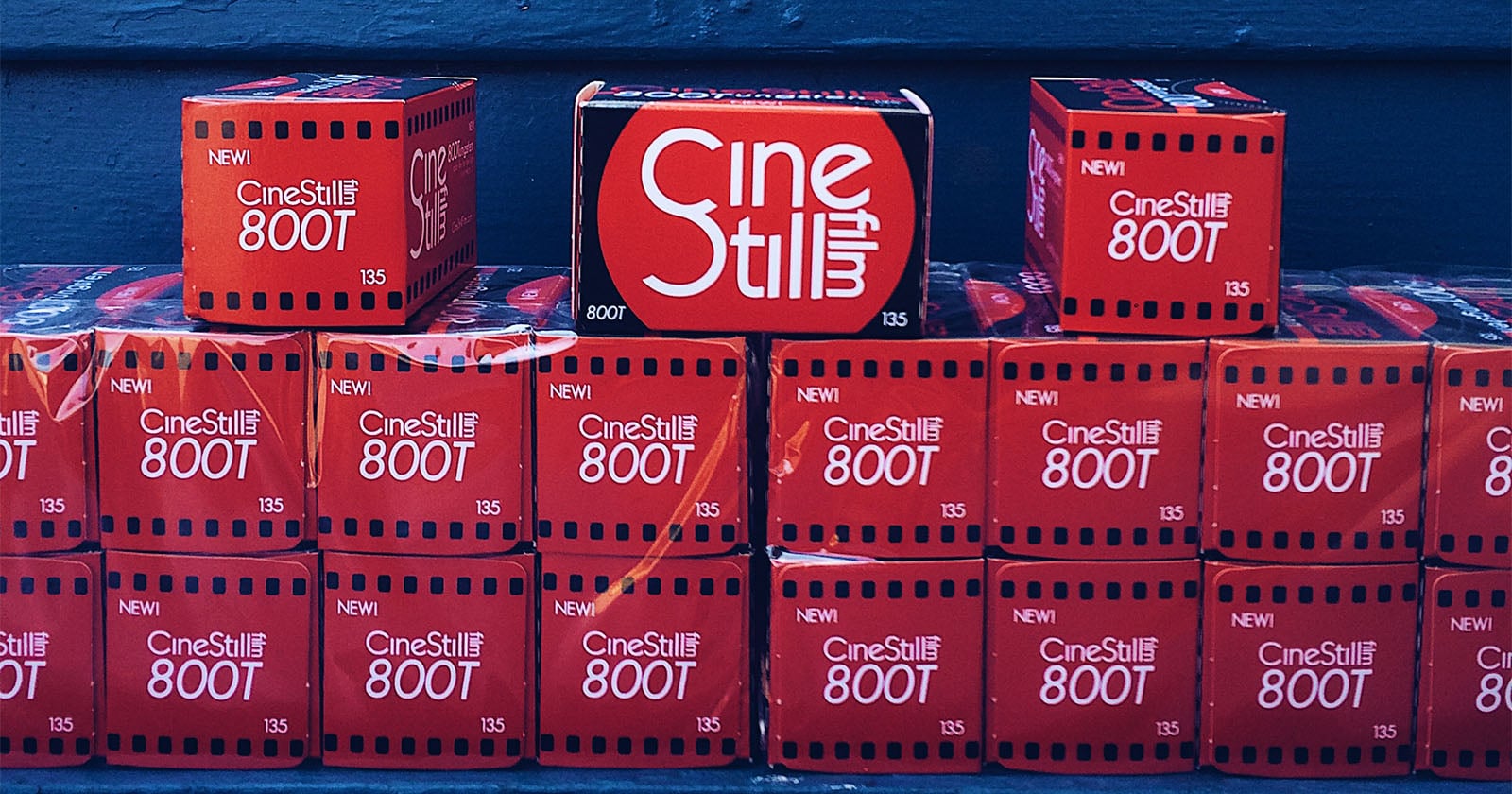
Most film stocks build a following on grain and color accuracy. CineStill 800T built one on a defect nobody wanted to fix. Aim it at a streetlight and the bulb bleeds into a soft red halo, and an entire generation of night photographers has organized its aesthetic around that glow. PetaPixel returned to the stock in its Film Friday column on September 11, 2026, calling 800T the most popular film in CineStill’s catalog and arguably its flagship.
The backstory explains the glow. The emulsion began life as Kodak Vision 3 5219, also known as Vision 3 500T, a motion picture stock built for tungsten lighting. Cinema film has historically carried a carbon-based remjet backing, and the ECN-2 chemical process includes a step that removes that layer safely. Push remjet through ordinary C-41 chemistry instead and it contaminates the tank, wrecking every other roll in the batch. That, plus minimum length requirements at motion picture labs, is why a lone 36-exposure roll of cine stock was a non-starter for decades.
Brandon and Brian Wright, the brothers behind CineStill, attacked both problems by stripping the remjet before the film was packaged, leaving a stock that any lab could run through standard C-41. Beta rolls went out in 2012, and after several more years of development plus a successful Indiegogo campaign, the film arrived in 120 as well.
Remjet, however, was also doing duty as an anti-halation layer. Without it, light passes through the emulsion, bounces off the camera’s pressure plate and reflects back into the film. That is the red halo, and it is the one thing 800T can do that no other color negative film will do for you.
The essentials, as CineStill lists them:
- Formats – 35mm 135 in 36 exposures, and 120 for medium format.
- Rating – EI 800, balanced for 3200K tungsten light.
- Processing – standard C-41 at a lab, or Cs41 at home.
- Push range – EI 200-1000 with no push, EI 800-2000 at one stop, EI 1250-3200 at two stops, EI 1600-3200 at three stops.
- Price – US$17.99 per roll, the same for 35mm and 120, on CineStill’s own store.
In practice, PetaPixel’s Zeb Andrews recommends overexposing by a stop and shooting at ISO 400, and reaching for a warming filter such as an 85 or 81 when you take the tungsten-balanced emulsion out into daylight. The color cast can also be dialed out later, since it is possible to remove much of it in printing or scanning. At the other end, the film can be rated as high as ISO 3200 with a three-stop push.
The verdict is unambiguous. Andrews rates the tonality above Kodak Portra, describing a film with more delicate tones and the latitude to hold shadows and highlights in genuinely nasty contrast. The catch is getting hold of it: supply from CineStill has been spotty, with long droughts between restocks. If you find a roll, the advice is simple – shoot it.