Anyone who has shipped a mobile robot knows the dirty secret of the business: the robot is only half the product. The other half is the back end that tracks the fleet, collects telemetry, draws maps, flags incidents and lets a human take the controls when something goes wrong. InOrbit, a Mountain View, California company founded in 2017, wants that half to stop being a reinvented wheel. It has released OpenRobOps (ORO), an open-source robot operations and fleet management platform, under the Apache 2.0 license.
The headline feature is standards support. InOrbit calls OpenRobOps the industry’s first reference implementation of ISO 21423, the upcoming interoperability standard that defines communication and data exchange between industrial mobile robots (IMRs) and fleet managers. Florian Pestoni, InOrbit’s founder and CEO, sits on the ISO working group behind it.
Escaping the build trap
Pestoni’s pitch is aimed squarely at robot makers. Many OEMs, he argues, fall into a “build trap”, spending years building and maintaining custom back ends, databases and user interfaces instead of working on the thing that actually sets their machines apart. “OpenRobOps gives robotics developers a production-grade, open-source foundation to escape the build trap, delivering the industry’s first ISO 21423 reference implementation and bridging the interoperability gap,” he said.
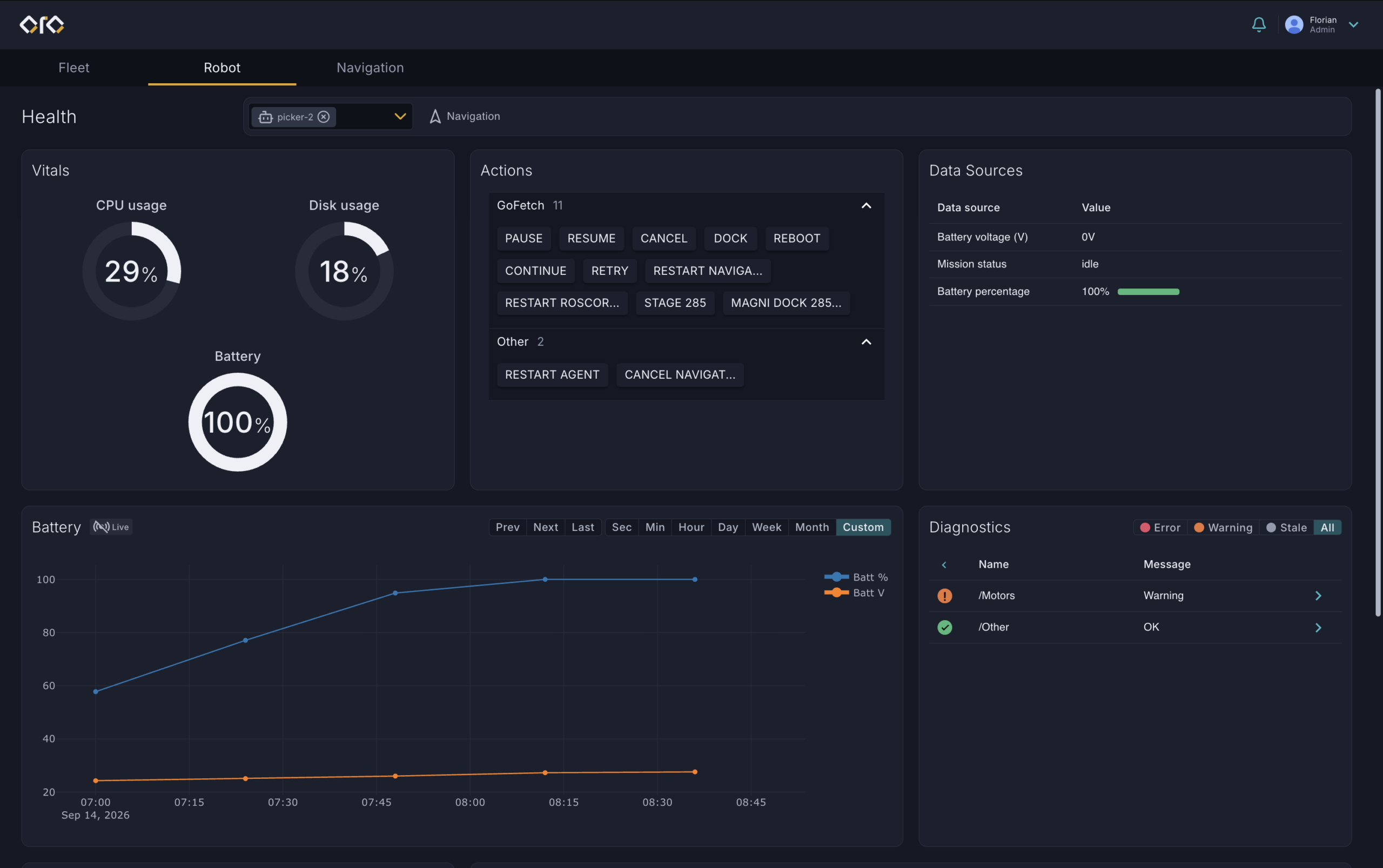
According to InOrbit, the platform covers the core jobs of a fleet manager:
- High-throughput telemetry ingest, with bandwidth-efficient data pipelines built for unreliable networks
- Real-time spatial tracking for interactive mapping, live camera views and teleoperation
- Configuration as code, so telemetry settings can be managed through Git CI/CD workflows
- Automated incident remediation, pairing anomaly detection with recovery actions
- Edge-to-cloud hybrid architecture, for on-premises or cloud deployments
- Native Open-RMF interoperability, with built-in adapters for multi-fleet systems
Pestoni stresses that ORO is not limited to warehouse carts. “It applies to any robot — it doesn’t really matter if it has wheels, two legs, four legs, etc.,” he said, adding that the release “levels the playing field, allowing more companies to offer complete offerings based on a proven technology.”
Under the hood
The code lives in the OpenRobOps/oro repository on GitHub. Its README describes a self-hosted stack built on Meteor 3 with React 18 for the web app, MongoDB as the main data store, a Mosquitto MQTT broker and a separate ingest service, with Protocol Buffers for messaging and native support for ROS and Open RMF. Docker Compose handles local services, and the repository also carries Terraform configuration and Kubernetes manifests.
The ROS comparison
InOrbit first announced plans to open-source ORO on February 4, 2026, when it also named Steve Cousins, former CEO of Willow Garage, to its board. Cousins, now executive director of the Stanford Robotics Center, draws a direct line to the Robot Operating System: “When we created ROS, our mission was to give roboticists an open ecosystem so they could stop re-inventing basic device drivers. OpenRobOps creates the same shift for robot operations and fleet management, while also enabling standards-based interoperability.”
The permissive license matters here. Under Apache 2.0, academic labs, startups and commercial enterprises can adapt, embed and deploy OpenRobOps without paying licensing fees. Project details are at openrobops.org.