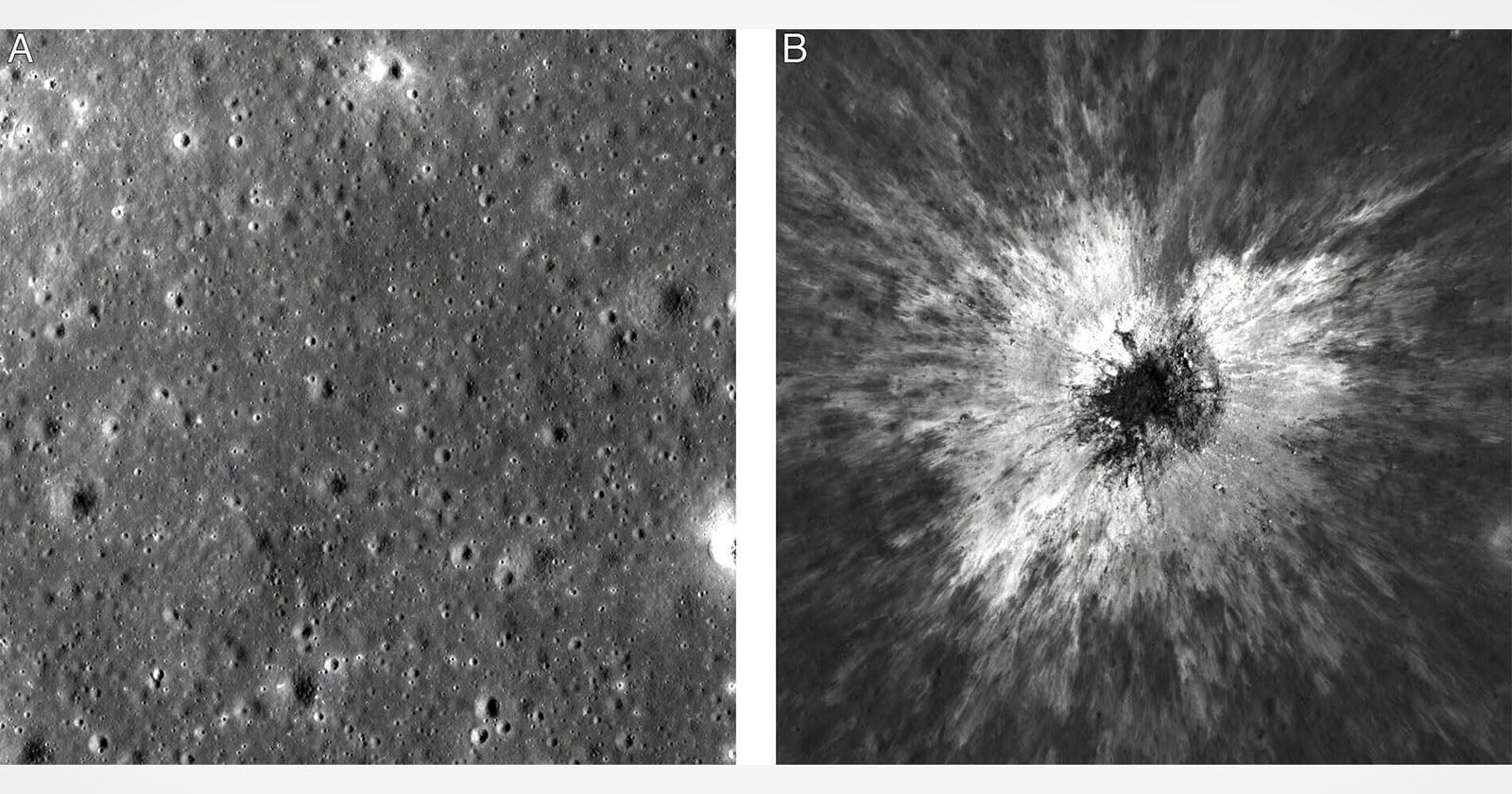
Photos of the Moon rarely show a change you can see. A new pair of images from NASA’s Lunar Reconnaissance Orbiter (LRO) does. The “before” frame shows ordinary grey terrain. The “after” frame shows a bright scar with a dark halo around it: McGetchin crater, the largest newly formed impact crater LRO has identified.
The numbers are large for a fresh crater. McGetchin measures about 728 feet (222 meters) across and about 141 feet (43 meters) deep. According to NASA, the asteroid or comet that made it was roughly the size of a three- to six-story building. The impact happened near the Moon’s eastern edge sometime between April 11 and May 22, 2024. PetaPixel reports that ejected material spread across more than 60 miles of lunar surface. It also says the crater is about three times wider than the previous record-holder among new craters found by LRO. NASA puts the odds of an impact this size at roughly once a century or less.
Found by comparing old and new photos
LRO’s Wide Angle Camera captured the crater in May 2024, but nobody spotted it for more than a year. On October 24, 2025, image-processing specialist Robert Wagner of Intuitive Machines was running a routine data-quality check on stacked imagery when he noticed an unusually bright area surrounded by a dark halo. “I just stopped, dropped everything, and started looking into what that spot was,” he said.
This kind of change detection is how LRO finds fresh craters. The spacecraft photographs the same ground again and again, and new craters show up when older frames are compared with newer ones. Over 17 years, researchers have identified at least 1,000 new impact craters this way and recorded about 100,000 other surface changes. McGetchin stands out because it is so large and so obvious.
Three instruments on one crater
After the discovery, the team used several LRO instruments:
- Wide Angle Camera (WAC): the global mapping imagery in which the bright spot first showed up.
- Narrow Angle Camera (NAC): high-resolution follow-up at 3 feet per pixel, including an oblique view of the crater.
- Diviner: the thermal instrument, which made observations from November 15, 2025 to February 18, 2026.
Diviner found a surprise: a zone about 4 miles wide around the crater that is roughly 16 degrees Fahrenheit colder at night than the terrain around it. The impact loosened the regolith (the Moon’s surface layer of dust and broken rock). Loose material holds less heat after sunset, so it cools faster.
Two papers and a name
Two studies describing the crater were published in Science Advances in September 2026. The authors call it “a statistically rare, effectively once-in-a-lifetime observation.” Lead researcher Tyler Powell said future observations from the surface would let scientists “correlate what we see and map from orbit with small-scale changes.”
The crater is named after Thomas McGetchin, a lunar scientist and former director of the Lunar and Planetary Institute in Houston. The International Astronomical Union adopted the name on May 4, 2026.
This is a rare case of photography catching the Moon’s surface actually changing. Two frames from the same orbiting camera, taken weeks apart, show a crater the length of two football fields appearing where there was none.