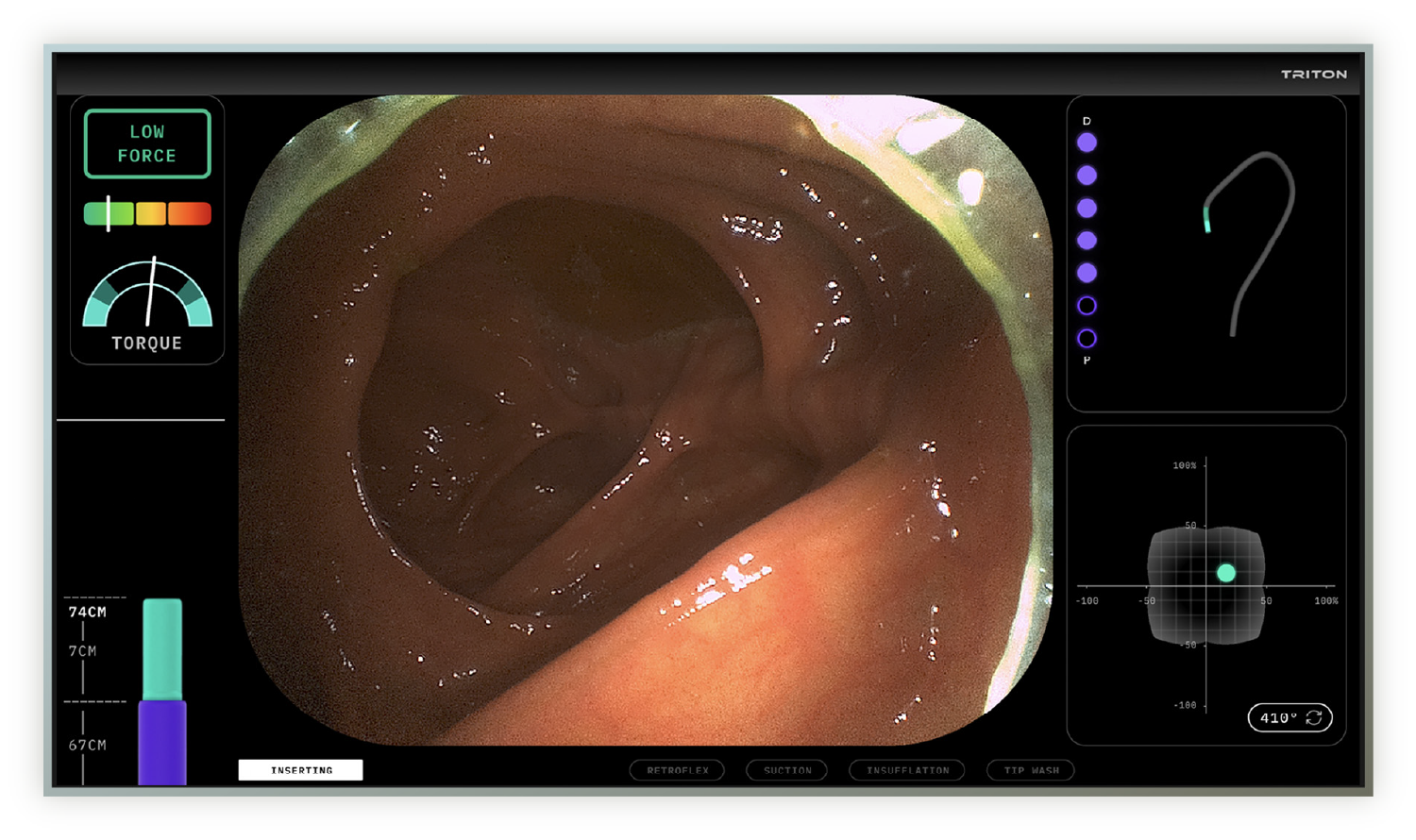
Colonoscopy is one of the most common procedures in medicine, and one of the most physically awkward. A long, floppy endoscope has to be pushed, twisted and coaxed around the bends of the colon, and when it loops or slips, the view gets worse and small lesions can be missed. Neptune Medical thinks a robot can fix that. On September 16, 2026, the Burlingame, California company announced that its Triton 1 System had received 510(k) clearance from the US Food and Drug Administration.
Triton 1 is a robotic platform for flexible endoscopy, cleared for diagnostic and therapeutic procedures throughout the colon. Neptune says it can raise any endoscopist’s capabilities in routine work and in harder cases:
- screening, surveillance and diagnostic colonoscopies;
- endoscopic mucosal resections (EMRs);
- endoscopic submucosal dissections (ESDs).
The core idea is stability. According to MedTech Dive, the robot gives physicians more steadiness and control over the endoscope, going after the instability that can leave parts of the colon unseen and let adenomas (precancerous lesions) slip by. Neptune’s own marketing describes Triton as a system that “combines robotics and AI in an ergonomic design”. It builds on the company’s proprietary Dynamic Rigidization technology, which Neptune has developed for endoscope control in upper and lower GI procedures.
What the first trial showed
Neptune’s case rests on CARE 1, a 50-patient first-in-human study. Its results were released in May 2026 and presented at Digestive Disease Week (DDW) 2026. The headline numbers:
- 100% cecal intubation, meaning the scope reached the far end of the colon in every case;
- an adenoma detection rate (ADR) of 54.2%, against an industry threshold of 35%;
- no adverse events;
- 67% lower average burden on the endoscopist than manual colonoscopy, measured with the NASA-TLX score;
- no patient repositioning, no abdominal pressure and no conversions to manual colonoscopy.
Anyone who has watched a nurse lean on a patient’s belly to help the scope around a turn will see why the last point matters. So does the ergonomics figure: endoscopists spend long days in cramped positions, and a robot that takes over some of that strain helps the doctor as well as the patient.
“Triton has the potential to fundamentally transform colonoscopy, creating a better experience for both physicians and their patients,” said Alex Tilson, Neptune’s founder and CEO. Jason B. Samarasena, MD, chief of the Division of Gastroenterology and Hepatology at UC Irvine, said Triton showed “the possibility of one system that can screen and treat anywhere in the colon, efficiently, thoroughly, and with minimal burden.”
Money and what comes next
Neptune raised $97 million in a Series D round in 2024, with Olympus and Sonder Capital among the investors, and launched a subsidiary, Jupiter Endovascular Inc., the same year. No pricing or commercial rollout schedule had been disclosed as of September 2026. Tilson framed the current generation as a learning tool that will “learn from endoscopists how robotics should integrate into their workflow”, and those lessons will shape a next-generation platform.
Neptune won’t have the field to itself. MedTech Dive names Olympus-linked Swan EndoSurgical and EndoRobotics among the companies working on robotic endoscopy.