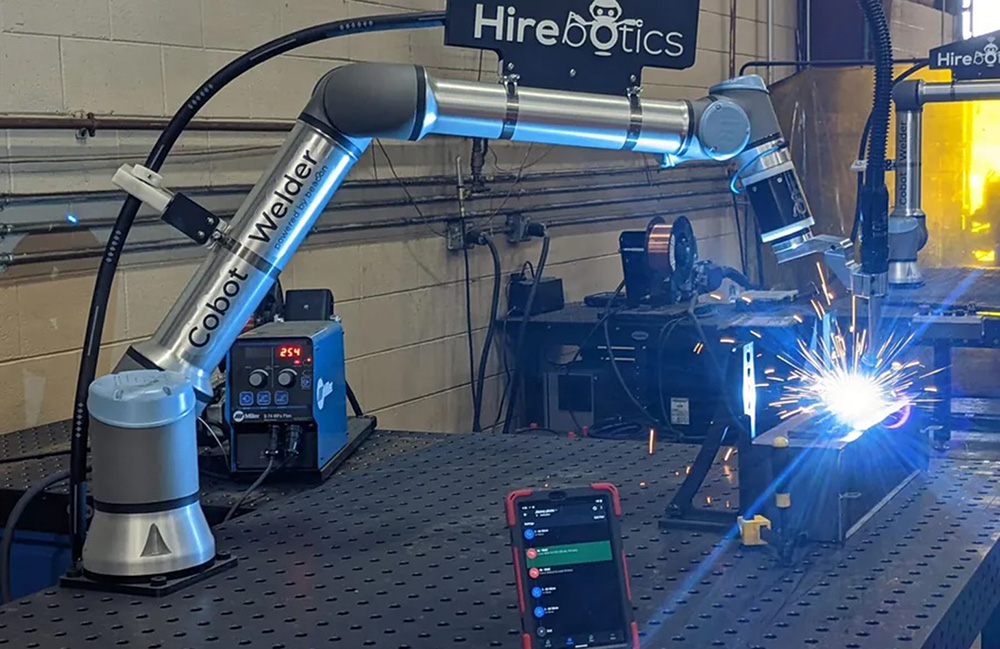
A collaborative robot is only as useful as its work envelope, and plenty of factory jobs don’t fit inside one. Some parts are too long. Others won’t stay still. Hirebotics, the Nashville-based maker of no-code cobot systems, tackled both problems at IMTS 2026 in Chicago (September 14–19, McCormick Place). It showed line tracking for its Cobot Painter and a modular linear rail for its cobot systems.
“Both capabilities come out of the same problem, from two directions: The work doesn’t fit inside a fixed work envelope. One is about how big or awkward the part is. The other is about the part not holding still,” CEO Matthew Bush told The Robot Report.
Painting on a moving line
Line tracking lets the Cobot Painter work on parts as they ride a conveyor, so the line doesn’t have to stop and nobody has to pull each part off for a stationary robot. A sensor detects an arriving part and starts the job automatically. The cobot then follows the part through its working area and holds its programmed painting path. Classic robotic line tracking usually needs specialist programming and integration. Hirebotics runs its version inside Beacon, its no-code, cloud-based platform. With the new feature, the Cobot Painter can:
- calibrate line tracking in Beacon, which teaches the robot the conveyor’s direction and movement;
- detect conveyor movement with an encoder and sensor;
- keep its painting path relative to the moving part and compensate automatically when conveyor speed changes;
- detect an arriving part, start the programmed operation and follow the part through the robot’s working area.
A rail for oversized work
A Hirebotics force- and power-limited robot has a 68.9-inch (175 cm) reach. That falls well short of a 12-foot (3.6 m) frame or a 20-foot (6 m) structural assembly. Customers have already been working around the limit with Magswitch magnetic mounts, inverted mounting and headstock-tailstock positioners. The linear rail makes that improvisation a standard product. It comes in 5-foot (1.5 m) increments or custom lengths and lets the cobot travel along a large workpiece instead of the part being moved again and again. The rail works across Hirebotics’ welding, plasma cutting and painting applications.
Bush sees the most demand in shipyards and marine fabrication, structural and heavy fabrication, trailers and truck bodies, agricultural and construction equipment, and tanks and vessels. The rail also stretches A/B workflows: the cobot works one station while an operator unloads and sets up the next part at the other, then moves across.
From manual to seventh axis
The rail is available now with manual positioning. For now, Beacon pauses the process and prompts the operator to move the cobot. Next, Beacon is set to verify that the cobot is in the right position before work continues. A fully automated version is planned for the end of 2026. Beacon would then move the robot itself, which effectively gives the cobot an automated seventh axis inside the same interface.
According to Bush, the goal is to “make automation applicable to more of the work manufacturers already do without requiring them to build a robotics department around it.” Hirebotics has not published prices for either feature.