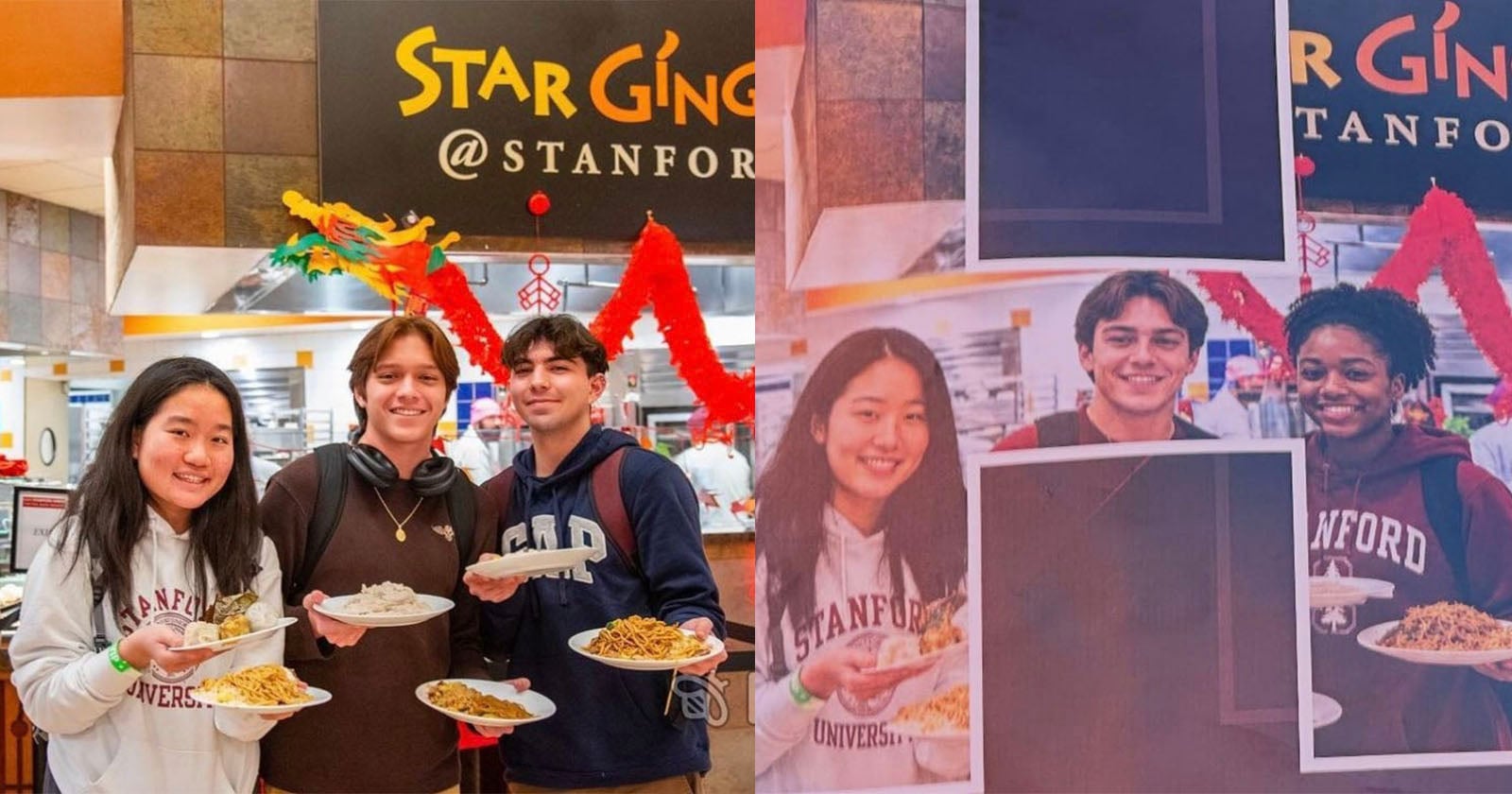
A promotional banner hanging in a Stanford dormitory has become an unplanned case study in what happens when generative AI gets pointed at real people. Stanford Residential & Dining Enterprises, the department that runs student housing and campus dining, built a custom banner around a photograph of three students holding plates of noodles at a Lunar New Year dinner at Stern Dining. The students on the banner were not quite the students in the photograph.
Billy Ramirez, a member of Stanford’s class of 2027, found that he had been edited out of the frame entirely. In his place stood an AI-generated Black woman. His two companions survived the edit, but with noticeably slimmer faces, and the group’s clothing had been quietly reworked into Stanford-branded merchandise.
Ramirez told The Stanford Review, the independent student paper that broke the story on September 21, 2026, that he was “immediately baffled” when he saw the result. “At first, I found it hilarious that they had used AI to completely change our appearances, including my race and gender,” he said. “But after looking at the comparison, I was also upset because I don’t agree with Stanford making those choices about how we were represented. Seeing my identity changed and being left out of the picture made me feel, in a way, silenced and erased from a representation that was supposed to include me.” Ramirez added to The New York Times: “I’m just a little surprised that a photo from years ago resurfaced.” He says Stanford never contacted him about the image.
On September 22, 2026, the university confirmed the AI work and conceded that it broke its own rules. “Stanford’s A.I. policy is clear: The use of A.I. in producing or altering images of Stanford people, events, research, facilities or achievements is strictly prohibited,” the university said. “Both the alteration and lack of disclosure in this case violate that policy. We are working with Residential and Dining Enterprises to provide additional training and ensure proper review of all materials.” The banner, displayed in the Governor’s Corner housing center, has been taken down.
What makes the episode technically interesting is how mundane the edit is. Nothing here required a research lab — face replacement, body slimming and wardrobe swaps are one-prompt operations in consumer tools, and the give-away was not a rendering artifact but a human being who recognised himself. The alterations included:
- a full identity swap, changing one subject’s race and gender
- slimmed faces on the two remaining students
- clothing replaced with Stanford merchandise
- no disclosure that the image had been altered at all
The impulse is not new, only newly cheap. As The New York Times noted, the University of Wisconsin-Madison doctored a crowd shot for the cover of its undergraduate application booklet in 2000 to make the campus look more diverse. Fixing it meant reprinting 100,000 brochures with a sunset photo on the cover. That took a photo lab, a budget and a decision. Now it takes a text box.