Rising supply costs, falling crop prices and weather that refuses to follow the almanac: that is the backdrop American farmers face in 2026, and CNH Industrial argues robotics is part of the answer. In an interview with The Robot Report published on September 25, 2026, Luca Ferrari, senior manager of robotics and breakthrough technologies at CNH, set out how the company sees autonomy fitting into that squeeze.
“Our users need to get more done with fewer resources,” Ferrari said. “They want something that is solving a real problem, that is easy to use, and that can create value.” The sharpest problem, in his view, is labor availability, above all at the moments when a farm cannot wait: planting, spraying and harvesting.
From helper to manager
Ferrari describes a shift in what farm automation is supposed to do. “We are moving from a paradigm where robotics and automation are not just assisting the operator with individual tasks,” he said. The direction CNH calls agentic systems means machines that take on whole operations rather than single steps of a job.
Data is the other half of the equation. CNH’s New Holland brand offers FieldOps, a farm management platform that monitors connected machines in real time. “Data is the new oil,” Ferrari said. “The real challenge is to get value out of that data.”
The R4, up close
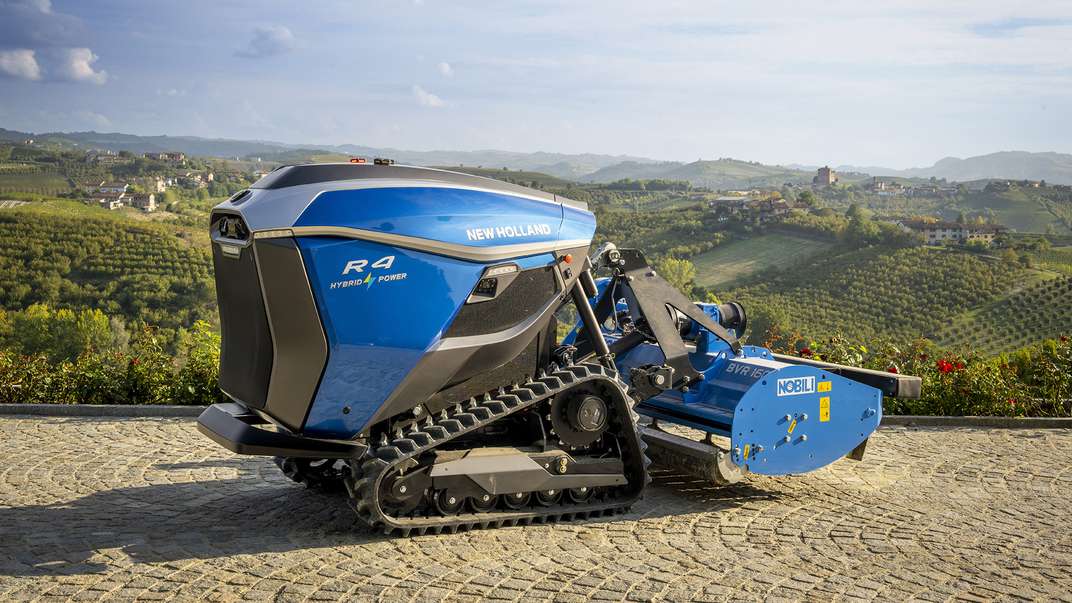
The hardware showcase is the New Holland R4 autonomous robot series, previewed at Agritechnica in Hanover in November 2025 and built for vineyards, orchards and specialty crops. It navigates with GPS and lidar, uses cameras to detect obstacles, and handles the repetitive jobs that eat hours between the rows: mowing, tillage and spraying. A single supervisor can manage one or more robots remotely through an app. The robots were developed at CNH’s R&D Centre in Modena, Italy, and New Holland’s Centre of Excellence for Specialty Harvesting in Coëx, France.
- R4 Electric Power: aimed at high-end narrow vineyards; 40kWh battery pack, 1.38m maximum height, 0.7m overall width, works in 1.0-1.5m crop spacings, weighs 1 tonne, 500kg hitch lift capacity.
- R4 Hybrid Power: aimed at orchards and fruit producers; 59hp / 44kW diesel engine plus two 4kWh batteries for electric-only running, 1,400kg, 1.2m wide, for crop spacings of 1.5m and above, 540rpm mechanical PTO and a 48V/12kW e-PTO socket.
According to New Holland, the Hybrid Power model has a power-to-weight ratio double that of a conventional specialty tractor. CNH’s sustainability report claims up to 90% lower emissions than traditional machinery and up to 20% lower cost of ownership than typical specialty tractors, with both versions able to run for up to eight hours. Limited production is scheduled for the first half of 2027; no prices have been announced.
Soil first, but the field is messy
Ferrari also pointed to soil health, which he called a farmer’s most valuable asset. Lighter robots reduce soil compaction, and precision robotic weeding, he said, can cut herbicide use by up to 80%.
The hard part is the environment itself. Terrain, weather, dust and constantly changing crop conditions make agriculture far less predictable than a factory floor, and Ferrari stressed that however complex the technology underneath, the interface a grower actually touches has to stay intuitive.