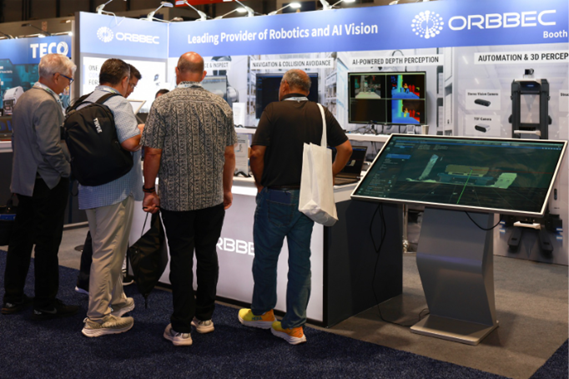
Robots are only as smart as their eyes, and at Automate 2026 in Chicago this week, Orbbec made a strong case that the next leap in industrial automation comes from sharper depth perception. The company rolled out a portfolio of industrial-grade 3D cameras built for the kind of messy, real-world conditions where lesser sensors quietly give up.
The headliner was the Gemini 435Le, a stereo 3D camera engineered for tough factory floors. It carries IP67-rated dust and waterproof protection and shrugs off a wide operating temperature range of -10°C to 50°C. Its depth range stretches from 0.20m all the way past 20 meters, with reliable performance landing within 6 meters — enough flexibility to cover bin-picking up close and palletizing across a room. Priced at US$499, it undercuts a lot of the industrial vision hardware it competes with.
For tighter quarters, Orbbec showed the Gemini 305g, an ultra-compact stereo camera designed to ride on a robot’s wrist. At just 116g, it adds almost nothing to a moving arm, yet delivers 4cm close-range depth with sub-millimeter accuracy. It’s fully compatible with the NVIDIA Jetson Orin platform and uses GMSL2/FAKRA connectivity, which means it slots neatly into modern edge-AI robotic stacks without a tangle of adapters.
Precision junkies got something to chew on too. Orbbec demonstrated a customizable 3D DLP structured light camera that hits roughly 0.07 mm VDI/VDE accuracy and 0.05 mm Z-repeatability at 0.5 m. That’s metrology-grade territory, the sort of fidelity you need for quality inspection and high-tolerance assembly where a fraction of a millimeter decides pass or fail.
Hardware is only half the story, though. The most forward-looking piece on display was the LingBot Enhanced Depth Filter for the Gemini 330 Series, which integrates with Robbyant’s Vision-Language-Action (VLA) models. In plain terms, that pairs clean depth data with AI that can interpret a scene and translate it into action — the building block for robots that don’t just measure their surroundings but reason about them.
Put together, Orbbec’s Automate 2026 lineup reads like a deliberate sweep across the perception spectrum: rugged long-range sensing, featherweight wrist-mounted cameras, lab-grade structured light, and an AI layer that ties depth to decision-making. It’s a portfolio aimed squarely at the moment robotics is living through right now, where the bottleneck is no longer motion but understanding.
For integrators trying to give their machines a more reliable sense of space, the message from the show floor was clear — better eyes are getting cheaper, smaller, and a lot more intelligent.