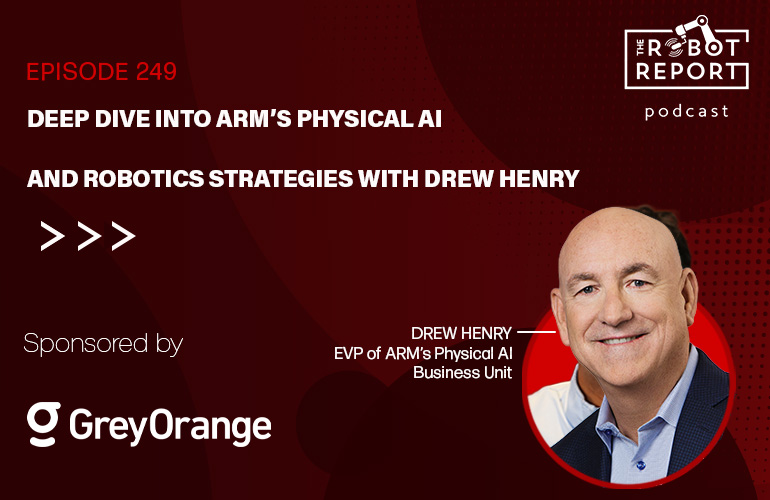
Robots don’t get the luxury of a data center’s air conditioning, redundant power and limitless rack space. They have to think on the move, inside a battery budget, often in milliseconds. That tension — between the soaring ambitions of AI and the hard constraints of the real world — sits at the heart of ARM’s robotics strategy, which Drew Henry, the company’s executive vice president for the Physical AI Business Unit, laid out in a recent episode of The Robot Report Podcast.
Henry’s remit is broad: he leads ARM’s strategy for the computing and software technologies that underpin automotive, robotics and autonomous systems. In other words, he’s responsible for the silicon brains that increasingly live not in the cloud, but in machines that move through the physical world. ARM calls this category “physical AI,” and it’s a deliberate framing — a way of separating the messy, embodied problem of robots from the cleaner, server-bound world of generative chatbots.
What makes the conversation worth listening to is how openly it grapples with trade-offs. Autonomous systems have to reconcile competing demands that rarely surface in a benchmark chart:
- Power and thermals — a robot or vehicle can’t dissipate heat the way a server farm can, so efficiency isn’t a nice-to-have, it’s the design constraint.
- Latency — perception and decision-making have to happen on-device, because a robot reaching for an object can’t wait on a round trip to the cloud.
- Safety and reliability — automotive and autonomous platforms demand a level of dependability that consumer gadgets simply don’t.
ARM’s role here is less about building finished robots and more about supplying the architectural foundation that countless companies build on. The pitch is familiar from the smartphone era, where ARM-based designs became the default: provide a power-efficient, scalable computing platform plus the software tooling around it, and let the ecosystem do the rest. Henry’s argument is that the same model maps neatly onto robotics, where the appetite for compute is enormous but the energy envelope is unforgiving.
It’s a strategy built on a bet that the next wave of AI won’t just live behind a screen. As large models push toward perception, planning and real-time control, the bottleneck shifts from raw cloud horsepower to what you can pack into a moving machine without melting it or draining its battery in twenty minutes. That’s exactly the gap ARM is positioning its Physical AI unit to fill.
Henry doesn’t pretend the path is finished — the discussion reads as a roadmap rather than a victory lap. But it’s a clear signal of where one of the industry’s most influential architecture companies thinks the action is heading: out of the rack and into the world, where the constraints are real and the math is harder.