Forget prompt engineering and eight-second AI clips. In downtown Los Angeles, artist Refik Anadol wants to prove there’s another way to think about machine-made art — and he’s built an entire museum to make the case.
Dataland, billed as the world’s first “museum of AI arts,” opened its doors on June 20, 2026, at the Grand LA complex. Cofounded by Anadol and studio partner Efsun Erkılıç, the space spans 35,000 square feet — with 10,000 of those reserved purely for the technology keeping the experience alive. Five galleries with soaring 30-foot ceilings are engineered for total immersion, and in its first two weeks the venue welcomed more than 10,000 visitors.
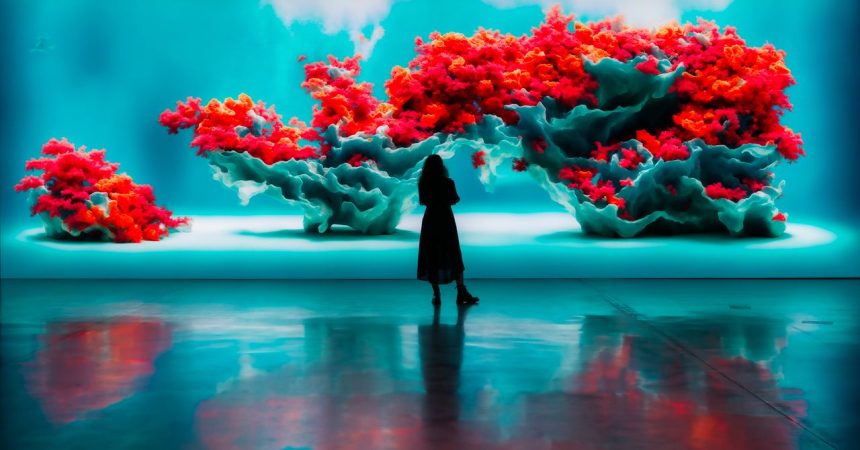
The centerpiece is Machine Dreams: Rainforest, an installation driven by Anadol’s Large Nature Model. Over three years, his team trained the system from scratch on 5 petabytes of raw data they collected themselves, traveling to the Amazon and other rainforests to capture the source material. Crucially, the archive was assembled with the consent and participation of researchers — a pointed contrast to the lawsuits dogging Silicon Valley’s biggest AI firms. Additional data came from prestigious institutions like the Smithsonian, whose Encyclopedia of Life alone supplied information on more than 2 million species.
What makes the exhibit genuinely novel is that it responds to you. Visitors receive a smartwatch and a U-shaped plastic collar — modified medical-grade wearables — that track biometric signals like heart rate and skin temperature. Walk through the main gallery during a simulated downpour and a watery circle follows your feet, stretching into a streak as you speed up. Wave your hand and the droplets scatter. The harness even emits scents: the smell of trees, the clean tang of a summer storm.
Anadol’s guiding question is deceptively simple: “Can artwork feel us back?” The answer plays out across several rooms:
- Infinity Room — follow a glittering hummingbird soaring over a neon forest, with vertiginous camera work reminiscent of Avatar’s aerial sequences.
- Latent Gallery — peek behind the curtain of the Large Nature Model; scroll the training data by category and watch a wall fill with a grid of, say, frog photos.
- Sanctuary — as a group enters, everyone’s biometric data is compiled into a swirling 3D representation of the room’s collective energy, generated once and never repeated.
Privacy, for once, is a feature rather than a footnote. The gallery “forgets” your data the moment you leave, though you can keep it via a personal token collected at the exit. And no, the restroom has “zero connection.”
Sustainability got attention too: Google DeepMind granted Dataland access to “experimental low-energy” resources, letting the museum run on Google Cloud with what Anadol calls “sustainable compute.”
Admission runs from US$49 to US$129 depending on the day and tier. Whether it converts the skeptics is another matter — but Anadol frames the whole project less as a tech demo than a mirror. “This is all about being human at the end,” he says. “It’s just an incredible tool.”