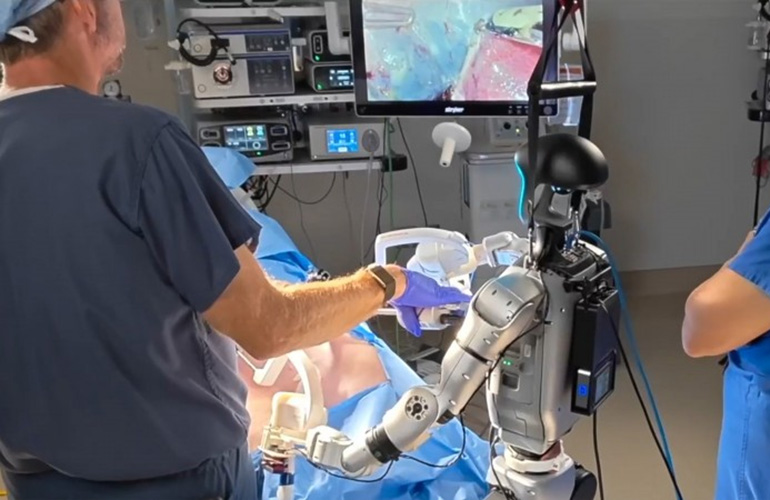
The da Vinci system taught the world that robots belong in the operating room, but it never pretended to be anything other than a bespoke surgical rig — bolted to the floor, purpose-built, doing one job supremely well. A team at UC San Diego has just pushed the concept in a very different direction: instead of a dedicated surgical platform, they handed the scalpel to general-purpose humanoid robots.
In a preclinical trial whose results were published in Nature on July 8, 2026, two teleoperated humanoids completed two live surgeries on large mammals, including a gallbladder removal. It marks the first time versatile humanoid robots — the kind envisioned for warehouses, homes and factories — have performed real surgical procedures rather than simulated ones.
The distinction matters. A da Vinci arm is exquisitely engineered for laparoscopy and nothing else. A humanoid, by contrast, is designed to operate in a world built for humans: it uses human-shaped hands, works at human scale, and can in principle pick up whatever tool the situation demands. That flexibility is precisely what makes the idea so tantalizing — and so hard to pull off.
Surgery is arguably one of the most punishing tests you can throw at a robot. It demands sub-millimeter precision, steady force control on soft, unpredictable tissue, and zero tolerance for error. That the UC San Diego robots managed a live gallbladder removal under human teleoperation is a meaningful proof of concept, even if it is a long way from an autonomous machine working solo.
Teleoperation is the key word here. A human surgeon remained firmly in the loop, driving the robots remotely rather than letting them improvise. That keeps a trained clinician’s judgment at the center of every incision while the humanoid supplies the dexterity and reach. It also hints at the longer-term promise often floated for this technology: the ability to bring surgical expertise to places that lack it, with a specialist operating from anywhere.
Why chase humanoids at all when specialized systems already work? Economics and versatility. A single robot platform that can be retrained for many tasks — rather than a fleet of one-trick machines — is the holy grail for the entire humanoid industry, and healthcare is one of the most valuable proving grounds imaginable. If one machine can assist in the OR one day and handle logistics the next, the cost calculus changes dramatically.
None of this dethrones da Vinci tomorrow. Purpose-built surgical robots remain vastly more mature, and a live-animal trial is exactly that — a trial. But the UC San Diego work reframes the question. The future of surgical robotics may not be about building ever more specialized arms; it may be about teaching the same adaptable humanoids we are already building for everything else to hold a scalpel steady.