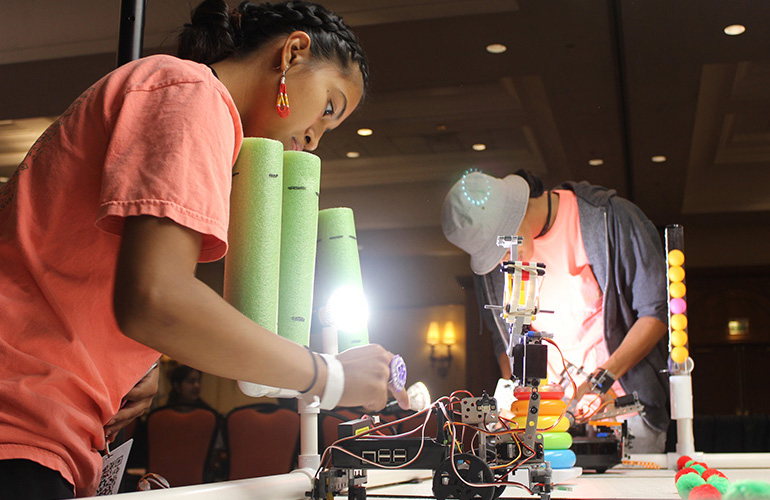
Robotics competitions have a bad habit of turning into a showcase for whichever parent has the deepest workshop and the steadiest soldering hand. Botball takes a deliberately different tack: the robots are fully autonomous, the code is written by students, and once the round starts, no one gets to reach in and rescue the machine.
Run by the KISS Institute for Practical Robotics, Botball has been putting hardware in the hands of middle and high school students since 1998. The pitch is refreshingly unglamorous — no radio-controlled heroics, no last-second driver saves. A robot either does what it was programmed to do, or it sits there and reminds everyone that debugging is a life skill.
That means real coding, not drag-and-drop blocks. Teams write their programs in C, C++, or Java, then set their machines loose to complete challenges on their own. The learning curve is the point: computer vision, sensor fusion and motion control all have to actually work under competition pressure, which is a very different thing from working on the bench the night before.
Every registered team gets a genuinely capable kit rather than a token starter box. At its heart is the KIPR Wombat robot controller, bundled with LEGO® pieces, compatible metal parts, motors, servos, an assortment of sensors, and a camera for computer vision. It is enough to build something that can see, decide and move — the three ingredients that separate a robot from a remote-control toy.
The full package for the 2026 season, BB 2026 Botball Registration – FULL KIT (NEW), is priced at US$2,750.00. That covers the hardware, the challenge access and a team’s place in the program for the year. Registrations for 2026 are open.
For younger builders or schools testing the waters, there is a lighter entry point. Junior Botball — the JBC Kit plus one year of curriculum and challenge access — comes in at US$575.00, trimming the ambition to fit smaller hands and tighter budgets without abandoning the core idea of autonomous, student-written robotics.
What makes Botball worth a look isn’t any single spec, it’s the philosophy baked into the rules. By barring live intervention and insisting on autonomy, the program forces students to confront the messy reality of making a machine act on its own. There’s no hiding behind a joystick, and no adult can quietly fix things mid-match.
It’s a level playing field in the truest sense: the outcome is decided by how well a team understood the problem and translated that understanding into working code. For a STEM curriculum, that’s about as honest a lesson as robotics can deliver.