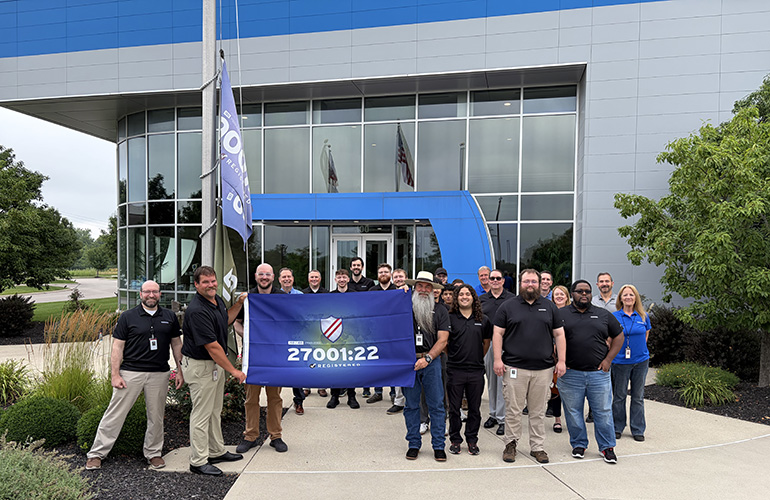
Industrial robots don’t just weld and stack pallets anymore — they generate, move and store enormous amounts of operational data, and that data is a target. Yaskawa America, one of the biggest names in motion control and robotics, has just formalized how it guards that information: on July 10, 2026, the company confirmed it earned independent certification to the ISO/IEC 27001:2022 standard.
If you’ve never had to think about information security frameworks, here’s the short version. ISO/IEC 27001 is the globally recognized benchmark for an Information Security Management System, or ISMS. It’s not a checkbox exercise — earning it means an outside auditor has picked through a company’s security posture across technology, day-to-day operations and organizational practices, then decided the whole thing holds together. The 2022 revision is the current edition of the standard, updated to reflect the modern threat landscape.
Yaskawa didn’t get there overnight. The certification is the payoff from a three-year, cross-functional initiative to harden the company’s information-security program — the kind of multi-year slog that touches nearly every department rather than living quietly in an IT closet.
There’s a genuine first here, too. Yaskawa America became the first organization certified under EAGLE’s newly ANAB-accredited ISO/IEC 27001:2022 certification program. ANAB accreditation matters because it validates the certifier itself — in other words, the body handing out the certificate has been vetted to a recognized standard, so the certificate carries real weight rather than being a self-declared badge.
Why should anyone outside a compliance office care? Because Yaskawa sits deep in the supply chains of manufacturing, automotive and automation customers, and those customers increasingly demand proof that their partners can protect shared data. A formal ISMS certification is exactly the sort of credential that shortens vendor due-diligence and reassures clients that sensitive design files, production schedules and connected-machine telemetry aren’t sitting behind flimsy defenses.
What the certification signals, in practical terms:
- Independent validation — a third-party audit, not an internal pat on the back
- Current standard — the 2022 edition rather than an older revision
- Breadth — coverage spanning technology, operations and organizational practices
- Longevity — the result of a sustained three-year program, not a last-minute scramble
For an industry racing toward smarter, more connected factories, the quiet infrastructure of trust — audits, accreditations and management systems — is becoming as important as payload ratings and cycle times. Yaskawa America’s move plants a clear flag on that front, and being the debut certificate holder under EAGLE’s freshly accredited program gives the milestone an extra bit of shine.