Cruise missiles aren’t exactly the sort of thing you assemble by hand, but the metal that goes into them still leans heavily on legacy tooling and slow, expensive fabrication. Machina Labs wants to change that — and it has just landed a heavyweight customer to prove the point.
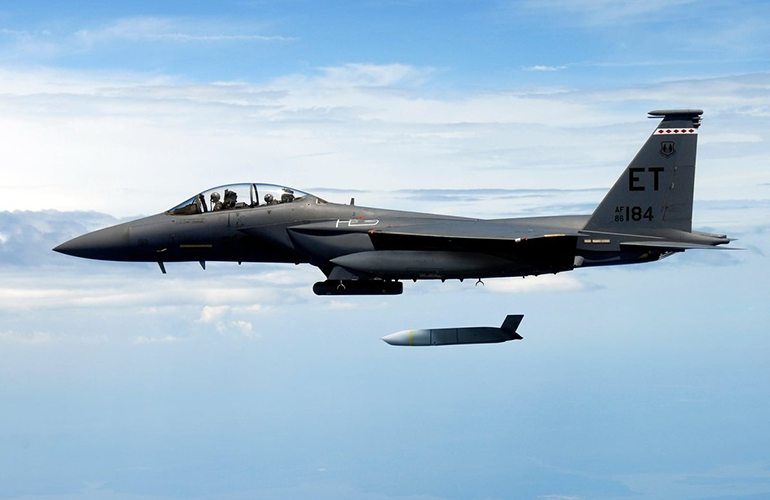
On July 15, 2026, the company confirmed a contract with Lockheed Martin to qualify robotically formed metal components for the JASSM program — the Joint Air-to-Surface Standoff Missile, one of the US military’s key long-range strike weapons. In plain terms, Machina’s robots will be shaping the structural parts and fuel tanks that hold these missiles together.
The star of the show is Machina’s flagship platform, RoboCraftsman, built around the company’s proprietary RoboForming process. Rather than relying on fixed dies and single-purpose presses, each RoboCraftsman cell packs two robotic arms that collaborate to bend and stretch sheet metal into complex geometries — no bespoke tooling required.
What makes the system genuinely interesting is how much it swallows into a single box. Every cell is containerized and handles the full workflow autonomously:
- Loading the raw material
- Forming the metal via the twin robotic arms
- Scanning for accuracy and quality control
- Trimming the formed part
- Drilling the finished component
That end-to-end integration is the whole pitch. Traditional metal forming spreads these steps across separate machines, workstations and setups, each adding cost, lead time and opportunities for error. By folding robotics, machine learning and RoboForming into one workcell, Machina positions itself as a contract manufacturer rather than an equipment vendor — you don’t buy the cell, you buy the parts it produces.
For a defense program, the appeal is obvious. Die-less forming means new part designs don’t require months of tooling development, and the same cell can pivot between geometries with a software change rather than a hardware overhaul. For something like JASSM, where production volumes and supply-chain resilience both matter, that flexibility is a strategic asset, not just a manufacturing nicety.
There’s a broader story here too. Defense primes like Lockheed Martin have spent years hunting for ways to speed up and de-risk their supply chains, and adaptive robotic manufacturing is increasingly part of that answer. A qualification contract is the gatekeeping stage — Machina has to demonstrate that its robotically formed structures meet the exacting standards demanded of mission-critical hardware before they can go anywhere near an actual missile.
Assuming the parts pass muster, production is expected to start in 2027. If it does, it will be a notable proof point: robots not just welding or moving parts on an assembly line, but autonomously forming the load-bearing metal of a weapon system from raw sheet to finished component.
It’s a long way from consumer gadgets, but it’s a striking glimpse of where industrial robotics is heading — machines that don’t just repeat one motion, but reason their way through an entire fabrication process.