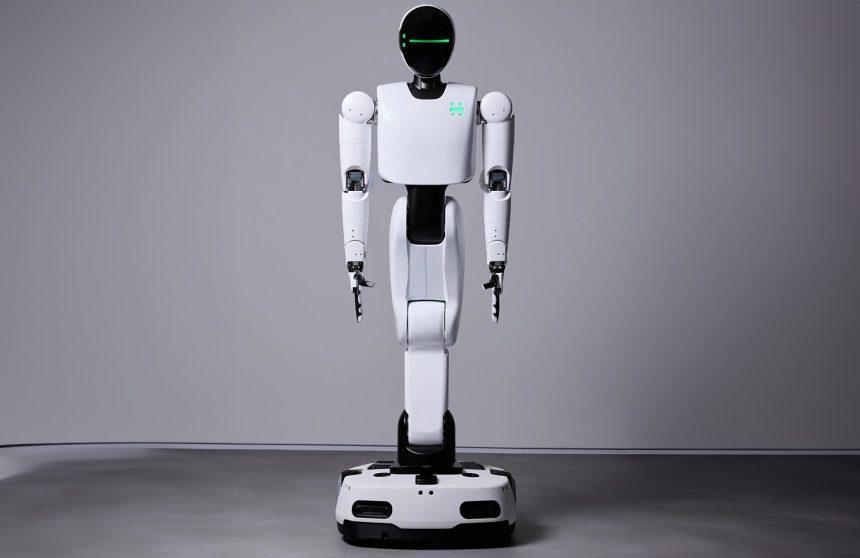
Forget the plodding, top-heavy bipeds you’ve seen stumbling through demo videos. South Korean startup Holiday Robotics has taken a different route with FRIDAY, a humanoid that skips legs entirely in favor of a wheeled mobile base — and the strategy has just attracted a hefty $105M in fresh funding, announced on July 13, 2026.
The logic is refreshingly pragmatic. Balancing on two legs burns enormous amounts of compute and energy for a payoff that mostly matters on staircases. FRIDAY instead pairs a dexterous upper body with a wheeled platform capable of gliding around at up to 1.9 m/s. That makes it quick and agile across the flat floors of warehouses, factories and labs — exactly where these robots are likely to earn their keep first.
Where FRIDAY really flexes is in its hands. The robot packs 64 degrees of freedom, with a remarkable 40 of them dedicated to its hands alone. That’s an unusually generous allocation, and it signals Holiday’s focus on genuine manipulation rather than photogenic waving. Backing up all those joints:
- Tactile sensing for feeling what it’s touching
- Force-aware control to modulate grip and pressure
- Fully backdrivable joints, so the robot yields safely when pushed rather than fighting back
Physically, FRIDAY stands 176 cm tall and weighs 115 kg — roughly human height, though considerably denser. To keep it working through long shifts, Holiday fitted hot-swappable batteries, letting an operator pop in a fresh pack and get the machine back to work without waiting hours for a recharge. It’s the kind of unglamorous engineering decision that separates a research toy from a tool meant to actually clock in.
Then there’s the price. Holiday isn’t chasing the six-figure exotica that dominates the humanoid conversation. The company’s short-term target is roughly $66,455 (₩100 million) once mass production scales up. That’s still a serious sum, but it lands the robot closer to a fleet-vehicle budget than a moonshot prototype — a deliberate bet that affordability, not spectacle, wins this market.
Commercialization is planned for the second half of 2026, with sales expected to begin in that same window. Holiday has set itself the goal of standing up a system capable of producing 100 units annually this year and shipping actual products to customers rather than just staging demos. As of now, FRIDAY is not yet on sale, and no public retail price has been confirmed.
It’s an ambitious timeline, and 100 units a year is modest by any industrial standard. But by ditching legs, doubling down on hands and keeping the sticker within reach, Holiday Robotics has drawn a clear line between what looks impressive and what actually gets used. With $105M now in the bank, we’ll soon find out whether the wheeled approach can outrun its two-legged rivals to real deployment.