By using this site, you agree to the Privacy Policy and Terms of Use.
Accept

GismoLand

Connecting You to Tech

  • Audio Video
    Audio VideoShow More
    LG C6 42-inch OLED42C6. Small-screen OLED that does cinema properly
    LG C6 42-inch OLED42C6. Small-screen OLED that does cinema properly
    4 Min Read
    Sennheiser CX 80U. Budget USB-C buds that make the case for cables
    Sennheiser CX 80U. Budget USB-C buds that make the case for cables
    4 Min Read
    Sony Bravia Theatre Trio with Rear 9 and Sub 9. The upgrade that fixes the bass
    Sony Bravia Theatre Trio with Rear 9 and Sub 9. The upgrade that fixes the bass
    4 Min Read
    Wharfedale Diamond 12.1i HCP. A 5.1 favourite gets quiet but smart revisions
    Wharfedale Diamond 12.1i HCP. A 5.1 favourite gets quiet but smart revisions
    4 Min Read
    BPI Counterfeit Vinyl Warning. The dark side of the record revival
    BPI Counterfeit Vinyl Warning. The dark side of the record revival
    4 Min Read
  • Mobile
    MobileShow More
    vivo X Fold6. Readers want the big foldable, just not at €2,200
    vivo X Fold6. Readers want the big foldable, just not at €2,200
    4 Min Read
    Apple iPhone Duo. The App Store gets ready to unfold before the phone does
    Apple iPhone Duo. The App Store gets ready to unfold before the phone does
    4 Min Read
    vivo Y32. A recycled name wrapped around an 8000 mAh battery
    vivo Y32. A recycled name wrapped around an 8000 mAh battery
    3 Min Read
    WhatsApp Restricted Chat. Locking a conversation to your main phone
    WhatsApp Restricted Chat. Locking a conversation to your main phone
    4 Min Read
    OnePlus 16. A 9,000mAh battery leads the spec sheet before the China launch
    OnePlus 16. A 9,000mAh battery leads the spec sheet before the China launch
    3 Min Read
  • Photo
    PhotoShow More
    ACC Art Books Giant Panda. China's national treasure in more than 80 photos
    ACC Art Books Giant Panda. China’s national treasure in more than 80 photos
    4 Min Read
    Martin Parr Common Sense. Ring Flash and Xerox Prints Come Back to Bristol
    Martin Parr Common Sense. Ring Flash and Xerox Prints Come Back to Bristol
    4 Min Read
    Allyson Schwab Wins Dismissal. A Wrestling Photographer's Posts Ruled Opinion
    Allyson Schwab Wins Dismissal. A Wrestling Photographer’s Posts Ruled Opinion
    4 Min Read
    Annie Leibovitz Sam Altman Portrait. A Romantic wanderer for the AI age
    Annie Leibovitz Sam Altman Portrait. A Romantic wanderer for the AI age
    4 Min Read
    Laguna Beach Proposal Shoot. A Videographer's Camera Caught a Racist Rant
    Laguna Beach Proposal Shoot. A Videographer’s Camera Caught a Racist Rant
    4 Min Read
  • Robots
    RobotsShow More
    Groceryshop 2026. Retail robots stop counting cans and start acting
    Groceryshop 2026. Retail robots stop counting cans and start acting
    4 Min Read
    SafeWorld Robot Safety Platform. Crash-testing robots before they meet people
    SafeWorld Robot Safety Platform. Crash-testing robots before they meet people
    4 Min Read
    AWS Physical AI Toolchain. One open-source pipeline from synthetic data to robot
    AWS Physical AI Toolchain. One open-source pipeline from synthetic data to robot
    4 Min Read
    Teradyne Robotics vs Elite Robots. A cobot software fight ends in a truce
    Teradyne Robotics vs Elite Robots. A cobot software fight ends in a truce
    4 Min Read
    FireDome Wildfire Defense System. A robotic launcher that fires retardant first
    FireDome Wildfire Defense System. A robotic launcher that fires retardant first
    4 Min Read
  • Technology
    Technology
    Modern technology has become a total phenomenon for civilization, the defining force of a new social order in which efficiency is no longer an option…
    Show More
    Top News
    Meta Glasses. Cover the recording light and Meta shuts your camera down
    Meta Glasses. Cover the recording light and Meta shuts your camera down
    September 2, 2026
    OpenAI Astra. When an AI gets too good at breaking into things
    OpenAI Astra. When an AI gets too good at breaking into things
    August 8, 2026
    Meta Glasses. The AI feature you paid for now runs on a monthly meter
    Meta Glasses. The AI feature you paid for now runs on a monthly meter
    July 1, 2026
    Latest News
    Microsoft Satya Nadella. Treat every AI model like an insider who might go rogue
    October 11, 2026
    Palantir ELITE. ICE Weighed Feeding Voter Rolls Into a Deportation Tool
    October 9, 2026
    BMW iX4. A coupe-roofed Neue Klasse EV built to go the distance
    October 8, 2026
    Plague Scare in Siberia. Why a Lab Accident Is Unlikely to Become an Outbreak
    October 7, 2026
  • Entertainment
Search
Sections
  • Mobile
  • Audio Video
  • Photo
  • Robots
  • Technology
  • Entertainment
  • Contact
  • Blog
© 2026 GISMOLand. All Rights Reserved.
Reading: Cornell Tech Optical Receiver. Beaming AI models onto chips with light
Share
Sign In
Notification
Font ResizerAa

GismoLand

Connecting You to Tech

Font ResizerAa
  • Robots
  • Technology
  • Mobile
Search
  • Home
  • Audio Video
  • Mobile
  • Robots
  • Technology
  • Entertainment
Have an existing account? Sign In
Follow US
  • Contact
  • Blog
© 2026 GISMOLand. All Rights Reserved.
GismoLand > Blog > Technology > Cornell Tech Optical Receiver. Beaming AI models onto chips with light
Technology

Cornell Tech Optical Receiver. Beaming AI models onto chips with light

gismo
Last updated: July 26, 2026 5:11 pm
gismo
Share
Cornell Tech Optical Receiver. Beaming AI models onto chips with light
SHARE

Imagine updating a robot’s brain not through a cable or a wireless handshake, but by shining a flickering pattern of light directly onto its processor. That’s the idea behind a new optical receiver developed at Cornell Tech, presented last month at the IEEE/JSAP Symposium on VLSI Technology & Circuits.

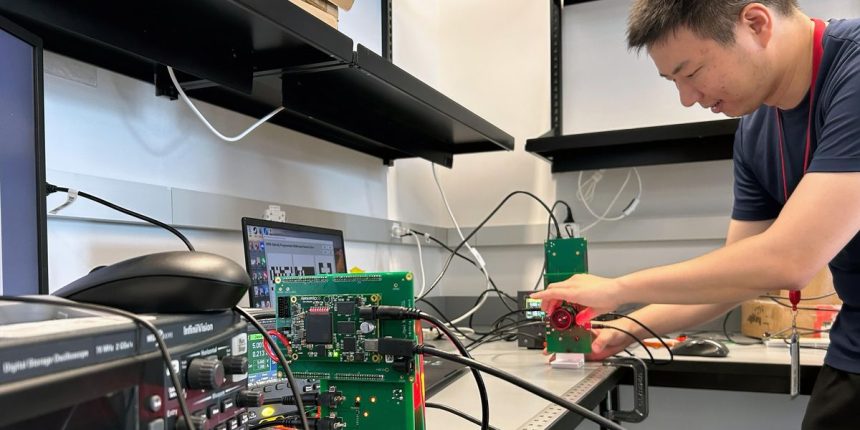
On a lab bench, postdoctoral researcher Yifan He aims the lens of an optical receiver almost a meter away from an LED throwing off a beam of red light. The attached monitor blinks, then shows a grid of squares that looks a lot like a QR code. But this is not your phone scanning a link. Instead of using an image sensor as a first step to decode data, the receiver rewrites its own memory using the photocurrents generated by the incoming light array — and that light could carry the parameters of an AI model.

Why this matters. Modern AI chips rarely have room to store every parameter of a model, so the overflow lives in dynamic random-access memory (DRAM). Shuttling data back and forth between DRAM and the processor over metal wires is expensive and inefficient, a bottleneck that only gets worse as systems scale.

Optical links move data at high bandwidth with far less energy loss than copper. The catch is that today’s optical receivers lean on power-hungry analog circuits to translate light into bits, which eats into the savings. The Cornell Tech approach sidesteps that by receiving rapid flashes of digital, QR-code-like matrices, letting chips adjust model parameters through fully digital optical communication.

How light flips the bits. In this setup, DRAM sits alongside the transmitter, while the receiver is folded into the processor’s static random-access memory (SRAM). The SRAM cells are modified to include photodiodes — when light strikes each one, it produces a current that flips the binary value stored in the cell.

Alignment is the tricky part. Since a transmitter and receiver won’t sit perfectly square to each other, the chip references a data frame describing the expected position of each pixel, then uses a calibration circuit to lock on to the real data even if the beam arrives slightly tilted.

The prototype’s limits. The transmitter in the lab is only a proof of concept, projecting a static 14×14-bit matrix through a metal mask. For real-world use, the team needs an optical transmitter that can rewrite the light matrix millions of times per second, pushing gigabits per second. They’re collaborating with optics groups to build one.

There’s another hurdle: the photosensitive bit cells are physically larger than conventional SRAM cells, meaning a chip fits less memory — a trade-off that could erode the efficiency gains. Shrinking those cells through transistor optimization and CMOS scaling is an ongoing effort.

The likely payoff is at the edge. Warehouse and factory robots could have their AI models refreshed via beamed light, saving time and energy, while memory-starved microrobots might one day benefit too. Commercialization is still years away, but as intelligence keeps migrating into the devices around us, light-based memory links could become a serious contender.


You Might Also Like

Microsoft Satya Nadella. Treat every AI model like an insider who might go rogue

Palantir ELITE. ICE Weighed Feeding Voter Rolls Into a Deportation Tool

AWS Physical AI Toolchain. One open-source pipeline from synthetic data to robot

BMW iX4. A coupe-roofed Neue Klasse EV built to go the distance

Plague Scare in Siberia. Why a Lab Accident Is Unlikely to Become an Outbreak

TAGGED: Cornell Tech, edge AI, optical computing, robotics, SRAM
Share This Article
Facebook Twitter Copy Link Print
Share
Previous Article Technics EAH-AZ100B1K. When rock royalty meets fluid-driven earbuds Technics EAH-AZ100B1K. When rock royalty meets fluid-driven earbuds
Next Article AI TikTok Spam. Five ways to catch a synthetic reskin before it fools you AI TikTok Spam. Five ways to catch a synthetic reskin before it fools you
Leave a comment

Leave a Reply Cancel reply

Your email address will not be published. Required fields are marked *

Latest News

ACC Art Books Giant Panda. China's national treasure in more than 80 photos
ACC Art Books Giant Panda. China’s national treasure in more than 80 photos
Photo
LG C6 42-inch OLED42C6. Small-screen OLED that does cinema properly
Audio Video
Gary Larson The Far Side. Ten panels where the joke is the whole point
Entertainment
vivo X Fold6. Readers want the big foldable, just not at €2,200
Mobile
//

Technology news network

Menu

  • Home
  • Audio Video
  • Mobile
  • Robots
  • Technology
  • Entertainment

Contacts

For any collaboration inquiries, please contacτ:

[email protected]

Follow US
© 2026 GISMOLand. All Rights Reserved.
Welcome Back!

Sign in to your account

Lost your password?