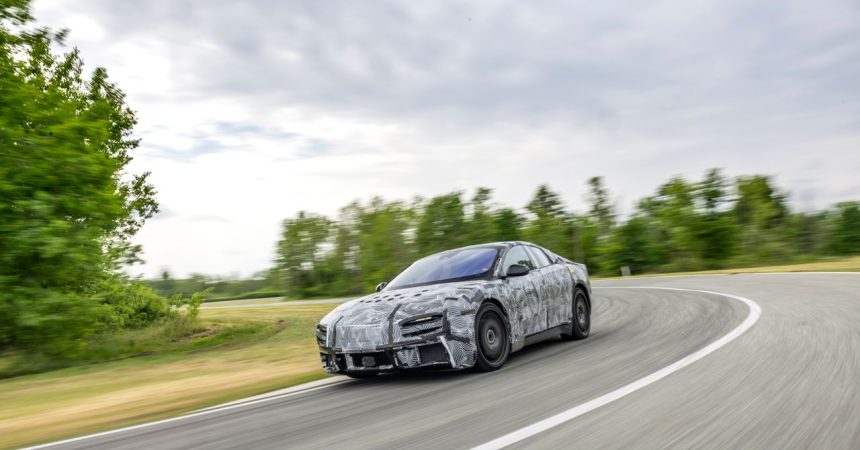
Ferrari fans have spent months treating the Luce the way Superman treats Kryptonite. The brand’s first fully electric car — engineered in Maranello but designed in California by Jony Ive’s LoveFrom studio — arrived without low-slung sportscar proportions, and by some accounts without the instant dopamine rush a Prancing Horse is supposed to deliver. Then WIRED drove a preproduction version, and the discourse suddenly looks a little foolish.
Let’s start with the hardware, because it’s staggering. The Luce packs four radial-flow permanent-synchronous e-motors producing a combined 1,035 hp, fed by a 122-kWh NMC battery on an 800V architecture with 350 kW DC fast charging. WLTP range is 529 km (329 miles), top speed hits 310 km/h (193 mph), and 0-100 km/h takes just 2.5 seconds. At 2,260 kg it is not light, yet Ferrari’s engineers insist — and the driving suggests — that it feels far nimbler than the number implies.
Physics explains why. The 800V battery is buried as low in the floorpan as possible, dropping the center of gravity 95 mm below Ferrari’s Purosangue and shrinking the yaw moment of inertia by 15 percent. The chassis is a new mix of hollow castings, extrusions and aluminium sheet — with a rear subframe (a Ferrari first) mounted on elastomeric bushes to tame noise and vibration.
A new vehicle control unit updates target metrics 200 times per second, coordinating rear-wheel steering, active suspension and four-motor torque vectoring. Chief test driver Raffaele de Simone frames the payoff simply: “What you feel is confidence.”
Two clever tricks stand out. A second “e-manettino” dial joins the traditional one, offering three modes:
- Range — power capped at 429 bhp, predominantly rear-drive
- Tour — 608 bhp with all-wheel drive
- Performance — 958 bhp
Then there’s Torque Shift Engagement, Ferrari’s answer to the one-dimensional way EVs deliver power. The right paddle serves up five power levels, the left one five grades of regenerative braking, conjuring the sensation of a conventional transmission and engine braking. It’s a step beyond the synthesized gearboxes in the Hyundai Ioniq 5 N and Porsche Taycan.
Even the soundtrack has been composed rather than faked. In Performance mode the Luce finds a voice with a harmonic rasp — “more Kraftwerk-adjacent than Pavarotti,” as WIRED puts it — generated by an accelerometer equalizing natural frequencies on the rear inverter. “There’s a different type of orchestra inside this machine,” says development lead Antonio Palermo.
The interior is unmistakably Ive: no touchscreen, elevated haptics, dials of unusual clarity, air vents that pivot with obsessive precision. The three-spoke wheel nods to classic Ferrari and feels superb.
The Luce was revealed in Rome on May 25, 2026, with first deliveries scheduled for October 2026 in Italy. It costs €550,000. Love it or hate it, this is a genuinely thrilling machine — just not the Ferrari anyone was expecting.