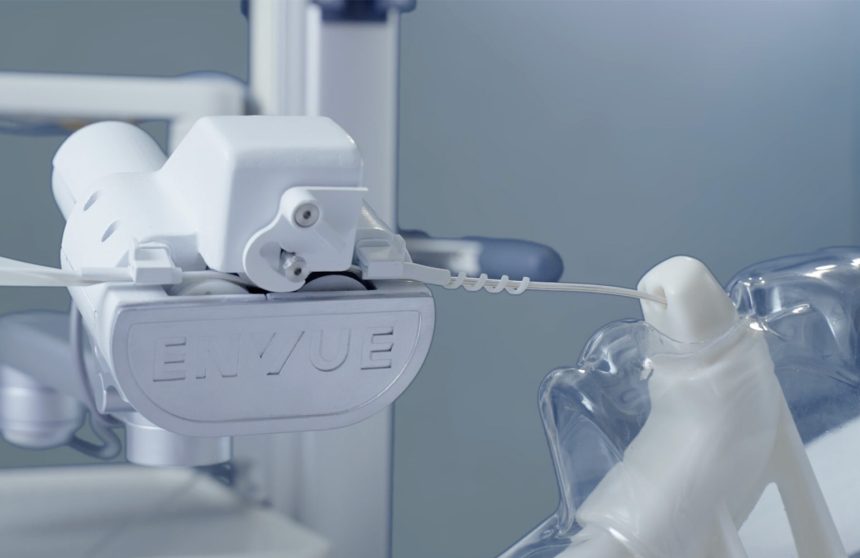
Placing a feeding tube sounds simple until you consider what’s involved: threading a thin catheter through a patient’s nose, past the stomach and into the small intestine, often blind, sometimes with X-ray confirmation. ENvue Medical wants to make that process smarter and steadier, and its answer is ENvue Drive, a robotic-assisted placement system unveiled on July 09, 2026.
The pitch here is refreshingly restrained. ENvue Drive is designed to assist the clinician, not replace them. The person performing the procedure stays in full control at all times — the robot handles the fiddly mechanics of advancing the tube while the human keeps clinical judgment and final say. It’s a philosophy that fits the delicate, high-stakes nature of the task, where over-automation is exactly the wrong instinct.
Under the hood, the system leans on ENvue’s own software stack. It integrates the company’s proprietary AI navigation platform, Ask Oscar™, with robotic-assisted tube advancement. In practice that means the system combines three things clinicians usually juggle separately:
- Artificial intelligence to interpret what’s happening inside the patient
- Real-time navigation to track the tube’s path as it moves
- Robotic-assisted procedural execution to physically drive the catheter forward with consistency a human hand can struggle to match
The appeal is obvious. Feeding tube placement is common in critical care, yet misplacement carries real risk, and repeated imaging to confirm position adds time, radiation and cost. A tool that pairs live navigation guidance with steady, machine-controlled advancement could tighten up accuracy and shorten a procedure that too often relies on feel and follow-up scans.
Before anyone gets carried away, a large caveat: ENvue Drive is still an investigational prototype. It has not been submitted to the U.S. Food and Drug Administration, and it is not cleared or approved for clinical use. In other words, this is a look at where ENvue Medical is heading rather than a product a hospital can order today. There is no pricing and no availability, because there is nothing to buy yet.
Still, the direction matters. Robotics in medicine has largely chased the marquee procedures — surgery, catheter labs, orthopedics — while bread-and-butter bedside tasks have stayed manual. ENvue Drive is a bet that those everyday interventions are where AI-guided robotics can quietly do a lot of good, one carefully advanced millimeter at a time. If the prototype clears the long regulatory road ahead, the humble feeding tube might become one of the first routine procedures where a robot lends a steady hand and the clinician still calls every shot.