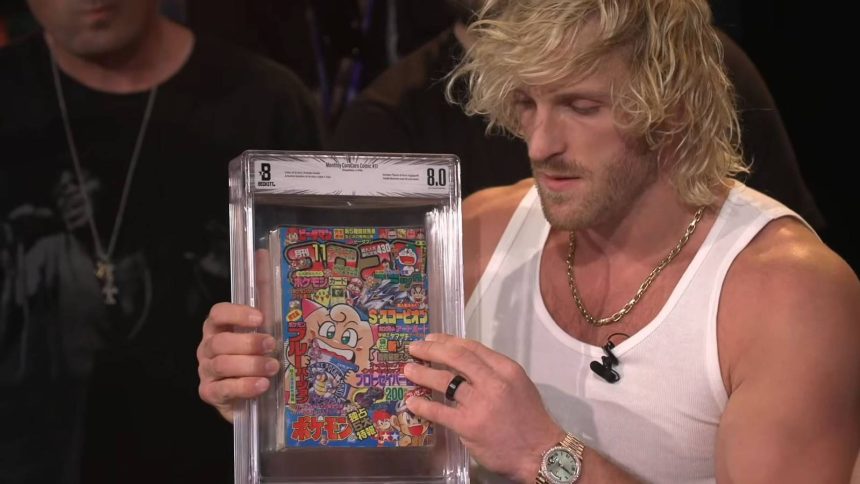
Betting big on nostalgia and hype is nothing new for Logan Paul, but his latest Pokemon card venture has turned into an expensive lesson in the difference between a promising gimmick and a payday. The YouTuber-turned-collector-turned-showman reportedly spent millions staging a lavish Pokemon event, broadcasting it to thousands of live viewers — only for the star attraction to arrive with visible imperfections.
For anyone outside the graded-card ecosystem, it might seem odd that a few flaws could sink an entire spectacle. But in high-end Pokemon collecting, condition is everything. A card’s value can swing dramatically on centering, surface scratches, edge whitening and print defects — the exact kinds of blemishes that professional graders scrutinize under magnification. When you’re marketing rarity and perfection to a crowd of paying spectators, visible imperfections are more than a cosmetic quibble; they’re a direct hit to the premise.
Paul has spent recent years building a reputation as one of the hobby’s biggest spenders, chasing trophy cards and turning their unveilings into content events. That formula has worked before — scarcity plus showmanship equals attention. The trouble is that the same audience drawn in by the promise of pristine collectibles is also the audience most likely to spot every flaw the moment a card hits the screen.
The economics here are unforgiving. Pouring a reported millions into production, promotion and the cards themselves only pays off if the payoff justifies the outlay. When the merchandise underdelivers on quality, the math flips fast:
- High upfront cost — event staging and card acquisition don’t come cheap
- Large live audience — thousands of viewers means thousands of witnesses to any misstep
- Condition-sensitive product — where imperfections erode both value and credibility
It’s a reminder that the collectibles boom, for all its viral energy, still runs on old-fashioned fundamentals. A card is only worth what someone will pay for it, and grade-conscious buyers pay a premium for flawless examples. Hype can inflate expectations, but it can’t sand down a scratched surface or recenter a misprint.
For Paul, the episode fits an increasingly familiar pattern of headline-grabbing bets that don’t always land the way the highlight reel suggests. The spectacle guarantees eyeballs; it doesn’t guarantee the goods hold up under them. And in a market where authenticity and condition are the whole game, being seen spending big on imperfect cardboard is exactly the kind of story that follows a collector around.
Whether this proves to be a costly stumble or just another chapter in Paul’s long-running Pokemon saga, it underlines a truth the hobby keeps relearning: no amount of production budget can polish a flawed card into a perfect one.