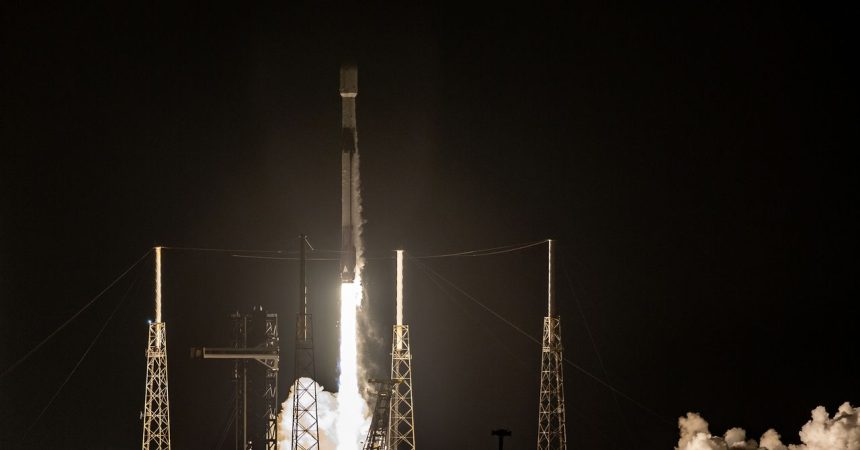
On August 5, 2026, at roughly 06:35 UTC, a spent SpaceX Falcon 9 upper stage — cataloged as 2025-010D — is expected to slam into the Moon’s sunlit western limb near Einstein Crater at around 8,750 kilometers per hour (5,400 mph). If the physics plays out as predicted, the collision could throw up a plume of debris bright enough to glimpse from Earth — provided you own a serious telescope and a lot of patience.
That would be a genuine first. No impact flash has ever been recorded on the sunlit face of the Moon, and this booster is forecast to hit exactly there, kicking up dust that could stand out against the black of space. The stage itself is a chunky piece of hardware: roughly 12 meters (39 feet) long, 4 meters (13 feet) wide, and weighing about 4,000 kilograms. It launched back in January 2025, carrying two landers to the Moon, and has been drifting ever since.
Here’s the interesting part: a spent rocket stage does not behave like a solid meteorite. Aerospace engineering professor David Goldstein of UT Austin describes it as “an empty eggshell, because it had all the fuel in it, and there is a rocket engine at one end that’s denser.” Instead of burrowing in like a cannonball, the shell should collapse from its edges inward, spraying a broad, low curtain of soil while punching a thin, faster spike nearly straight up.
A new preprint led by doctoral candidate William Jo ran the crash through a high-resolution physics simulation. His “best-case” 2D model assumes the stage arrives engine-first, straight down — like dropping a pin on its head. Reality is messier; a glancing angle would produce a smaller, dimmer plume. “I would view our study as the most optimistic in terms of generating sprays,” Goldstein says.
Whether Earthbound observers actually catch it is another question. Astronomer Laurence Trafton notes a plume reaching 50 kilometers past the limb would span about 28 arc seconds — easily resolved by a small telescope. The catch is contrast: the plume could be 30 to 300 times fainter than the blazing Moon beside it, so you’ll need “a very steady mount.” The peak should arrive about 90 seconds after impact, which Trafton calls “long enough for an observer to witness.”
Geography matters, too. The flash must be caught at night, and viewers far north will be squinting through triple the usual atmosphere. Trafton reckons the US Southeast has the best odds.
Beyond the spectacle, there’s science at stake. Debris could fly out at 300 to 400 meters per second, and lunar rock is brutally abrasive — a preview of the dust-control nightmares awaiting future crews. As Goldstein puts it, recalling Apollo: “you can see they were dirty — covered in dirt.” Set an alarm, aim at the bright limb, and pray the sky holds still.